If a preprint is inconsistent with a personal blog and a journal, the personal blog and journal shall prevail.
Abstract
Discussions of the capability boundaries of AI agents currently harbor an implicit “hypothesis of absolute interactional universality”—the assumption that an AI system with sufficiently general intelligence can achieve unrestricted, universal applicability in any interactional situation. Mainstream investment in artificial general intelligence (AGI) largely takes this unstated premise for granted. Yet the human–agent interaction (HAI) capabilities of AI systems within the contemporary social-communication ecology have never been systematically examined at the level of dense intraindividual time series—apart from interview- and questionnaire-wave panel studies—and idiographic variance structures remain unexplored. Drawing on preliminary data from a two-year intensive longitudinal study, this article proposes a Systemic Coupling Perspective (SCP) on human–agent interaction: human–machine interaction is not a freestanding event between a person and a technical medium but an ecology that emerges from a coupled system co-constituted by the social condition field, the human person, platform infrastructure, and temporal rhythm. Whereas theories such as MASA, CASA, and parasocial relationship research explain how interactions unfold once they are already possible, this article borrows a Kantian question—asking what makes interaction possible before it occurs—while treating these conditions of possibility as a posteriori, historical, and changeable structural facts. It derives a propositional system (P1–P8) with observation indicators and falsification conditions and offers a consistency demonstration through a case. In dialogue with Bourdieu’s field theory and actor–network theory (ANT), it renders an implicit premise explicit, operationalizes it, and subjects it to falsification. Its argument points toward supplementing HCI research with a “coupling paradigm,” not toward rejecting AGI/ASI research itself.
Note: This article aims to propose a theoretical framework and a research direction. The empirical materials serve only as illustrative demonstration; the full empirical test will be reported in a separate article.
Keywords: Hypothesis of Absolute Interactional Universality; Systemic Coupling Perspective (SCP); Human–Agent Interaction (HAI); MASA paradigm; parasocial relationship theory; ergodicity fallacy
1. Theoretical Predicaments of Human–Machine Interaction in the Age of AI
As contemporary artificial general intelligence (AGI) has been invested with the promise of reshaping the paradigm of human–machine interaction (Guzman & Lewis, 2020), the definition of AGI has oscillated with the diverging expectations of academia and industry. Before the advent of ChatGPT, definitions of AGI drifted away from early philosophical speculation on the nature of intelligence and machine minds—such as Weizenbaum’s (1976) and Searle’s (1980) debates over whether machines could “possess” a mind—and moved toward practically oriented measurability: recent work takes the generality of skill acquisition and problem solving as its starting point (Chollet, 2019; Hernández-Orallo et al., 2021) and defines AGI as highly autonomous systems that match or exceed human capabilities across broad economic activity (OpenAI, 2018).
In February 2026, Turing Award laureate Yann LeCun, together with collaborators at multiple institutions, published a paper arguing that the AGI currently pursued by industry suffers from definitional vagueness and is difficult to put into practice (Goldfeder et al., 2026). In August 2025, OpenAI CEO Sam Altman publicly stated that AGI is “not a super useful term” (Browne, 2025); in March 2026, OpenAI’s public framing shifted toward “AI that can do autonomous research” rather than “general intelligence” (Metz, 2026); and since October 2025, a statement calling for a pause on the development of superintelligence has gathered signatures from large numbers of scientists and business figures worldwide (Future of Life Institute, 2025).
Meanwhile, definitions of AGI have grown more conservative. The skepticism voiced to date has come almost entirely from philosophical speculation, ethical reasoning, or industry commentary (Bender et al., 2021). A key communication-theoretic corollary of AGI generality—whether humans’ emotional responses to AI follow laws that hold consistently across individuals—has never been tested with longitudinal intraindividual data, even though this is precisely the question that the intraindividual-variability program (Hamaker, 2012; Molenaar, 2004; Molenaar & Campbell, 2009) posed long ago and that communication research has yet to take up empirically. The same absence marks the mainstream theoretical frameworks of human–machine communication: although the paradigm represented by MASA has revealed the micro-mechanisms by which media cues trigger social responses (Lombard & Xu, 2021), no study has tested the applicability boundaries of that model at the level of dense intraindividual time series.
One objection must be confronted head-on: who actually advocates the “hypothesis of absolute interactional universality”? As far as the literature known to this article is concerned, almost no researcher has ever stated it in explicit form—which is exactly the point. The hypothesis operates implicitly. First, it is implicit in the decision logic of industrial investment: when investment is made in the name of “generality” while deployment plans assume that the same system can enter any sociocultural scene without major adaptation, “generality” is in effect being priced as “universality.” Such deployment narratives are publicly documented: Google has framed its goal of deploying AI assistants across its product line as “making AI helpful for everyone” (Pichai, 2024), and the OpenAI Charter promises an AGI that “benefits all of humanity” (OpenAI, 2018)—both defaulting to the premise of “one system, universally beneficial.” For scholarly criticism of the way AGI discourse treats generality as a deployment promise, see Blili-Hamelin et al. (2024); for a philosophical critique of the instrumental imagination of AGI and of its goal setting, see also Lott and Hasselberger (2024). Second, the hypothesis is implicit in the default premises of certain theoretical paradigms: when research treats “interaction can occur” as a starting point that needs no argument and proceeds only to discuss how interaction unfolds, the conditionality of interaction has been excluded by stipulation. Third, it is implicit in the extrapolation habits of benchmark evaluation: generality on benchmarks is assumed to be convertible into interactional effectiveness in deployment—published critiques of such unstated assumptions in AGI discourse can be found in Blili-Hamelin et al. (2024), and Hernández-Orallo et al. (2021) further supply direct measurement-level evidence that generality and capability coverage can be decoupled. This article therefore does not attack an explicit position that actually exists; it renders this unstated premise explicit as an operational, refutable proposition (see the operational definition in Section 2.1[4]) and then subjects it to examination with empirical materials and a propositional system.
Although the concept of AGI and the paths toward its realization remain broadly contested, these disputes jointly reveal a theoretical problem more basic than AGI itself: current human–machine interaction research focuses mainly on how interaction occurs and rarely asks how interaction is possible. Whether AI is regarded as a social actor or interaction is attributed to model capability, most theories assume that interaction does occur and proceed directly to its manifestations. Yet interaction is never an event that exists independently of its social environment, platform structure, individual position, and temporal process. Under different social conditions, the same AI, the same user, and even the same interactional task can yield entirely different outcomes. This means that before interaction mechanisms can be discussed, a more basic question must be answered: what exactly constitutes the conditions under which interaction occurs? We argue that this question names a research gap that current human–machine interaction theory has not adequately addressed (Guzman, 2018). More precisely, within human–machine communication (HMC) research, work that takes the conditions of interaction’s occurrence as its explicit object of study is still lacking—and this is the theoretical starting point of this article. To prevent terminological slippage, three distinctions are made at the outset. When referring generically to interaction between humans and technical systems, this article retains the “human–machine interaction” (HCI) tradition; when discussing meaning-making between humans and intelligent media within the communicative lineage, it uses “human–machine communication” (HMC); and when the interactional counterpart is an AI agent endowed with a personified identity, memory mechanisms, and continuous presence, so that the interactional structure exceeds the “human–medium” frame, it uses “human–agent interaction” (HAI), following the handling at the opening of Section 3. The three terms share the same object of analysis with increasing precision; the object of the Systemic Coupling Perspective—the conditions of possibility of interaction—runs through all three. The article’s framework affiliation is also stated explicitly: SCP is a general theory of the conditions of possibility of interaction and does not take AI as its only object (see the note on the boundary of applicability at the end of the text). Within this article, AI serves two roles: at the level of P6 and P8 it is the object of research, but more fundamentally it is an instrument—the only interactional counterpart whose cognitive capability can be frozen while platform conditions alone are varied, thereby making the independent contribution of platform conditions observable (the case is nonetheless not called an “experiment”; the reason is given in the positioning statement in Section 3).
2. Major Research Paths in Human–Machine Interaction Theory
In the course of its development, human–machine interaction research has seen theoretical perspectives shift stepwise from an instrumental understanding to a social understanding, and then to a relational understanding. Early HCI research rested mainly on an instrumental-rational framework (Guzman & Lewis, 2020), treating the computer as a technical medium for achieving human goals and concentrating on system usability, operational efficiency, and user task completion. Within this paradigm, interaction was understood as a subject’s control of a tool, and technology itself was assigned no independent social meaning.
As AI systems gradually acquired natural-language processing, emotional expression, and social-cue simulation, researchers began to ask why humans respond to technical objects in social ways. Research in the CASA (Computers Are Social Actors; Reeves & Nass, 1996) paradigm showed that when a computer presents sufficiently many social cues, users automatically recruit the social-cognitive rules they apply to human counterparts (Epley et al., 2007; Nass & Moon, 2000). MASA (Media Are Social Actors) subsequently extended this perspective to media environments, emphasizing that the social attributes presented by media can shape users’ interactional behavior. This line of research broke with the traditional instrumental view and brought artificial systems into the analytic framework of social interaction (Xu, 2019).
In parallel, relational research began to attend to the enduring psychological bonds formed between people and media (Turkle, 2011). Parasocial relationship theory holds that audiences can form emotional bonds with media figures analogous to social relationships (Giles, 2002). In the context of artificial intelligence, this line has extended further to emotional attachment, trust, and companionship between users and intelligent systems (Skjuve et al., 2021). Yet whether in the social-actor or the relational paradigm, the core concern has remained the psychological mechanisms and relational manifestations that follow interaction—how users respond to AI, and how humans and AI come to form bonds.
Existing human–machine interaction theory has therefore continuously broadened the understanding of interactional processes, but its analytic focus remains fixed on interaction mechanisms and interactional outcomes, and it still lacks systematic theoretical discussion of the systemic conditions, structural relations, and dynamic processes on which the occurrence of interaction depends. This article does not deny the explanatory power of existing theories over concrete interaction mechanisms; it attempts a further question: before those mechanisms can operate at all, what conditions make human–machine interaction possible?
2.1 AGI, ASI, and Absolute Universality
Before entering the empirical analysis, the core concepts discussed in this article must be clarified.
(1) The tiered definition of AGI. Morris et al. (2023), in the Google DeepMind framework, proposed a six-level taxonomy of AGI. Rating AI systems along two dimensions, “performance” and “generality,” the framework grades systems from Level 0 (no AI) to Level 5 (superhuman). Level 5—”superhuman,” meaning performance exceeding that of 100% of humans on a broad range of tasks—is the level commonly referred to as ASI (Artificial Superintelligence).
(2) The strict definition of ASI. In the report From AGI to ASI, Genewein et al. (2026) further define ASI as stably outperforming, on nearly all cognitive tasks, the output of “tens of thousands of top experts, well coordinated, collaborating continuously on a single problem for a decade.” A distinction must be drawn: ASI is a milestone on the capability continuum, whereas UAI (Universal AI/AIXI) is the theoretical absolute ceiling. The latter, formalized by Hutter (2005), is the system that maximizes expected cumulative reward in any computable environment.
(3) The distinction between “general intelligence” and “universal intelligence.” The two kinds of intelligence are conventionally distinguished as follows: general intelligence denotes a system’s ability to perform the broad range of cognitive tasks that humans typically perform, whereas universal intelligence denotes a system’s ability to maximize expected cumulative reward in any possible environment (Legg & Hutter, 2007). The two are concepts at different levels—generality and capability coverage can be decoupled at the level of measurement (Hernández-Orallo et al., 2021).
(4) An operational definition of “absolute interactional universality.” This article defines the hypothesis of absolute interactional universality as follows: an AI agent, by virtue of its general cognitive capability alone, can achieve unconditional and complete interactional effectiveness in any sociocultural situation, any interactional relationship, and any combination of task goals. The hypothesis in effect conflates “generality” with “universality,” wrongly extrapolating general capability on cognitive tasks into universal applicability across interactional situations. It is this hypothesis—and not AGI or ASI as a technical goal in itself—that is the object of this article’s argument. The weighting of the argument must also be made explicit: the article’s positive program—the Systemic Coupling Perspective and propositions P1–P7—stands independently of this negative diagnosis; the critique of the hypothesis is a derived conclusion and research motive that emerges once the positive program is under way, not the premise on which the article as a whole rests.
(5) Embodied intelligence and its theoretical tension with human–machine interaction. Beyond the dispute over AGI definitions, another technical line brings this article’s question closer: the 2025 Government Work Report mentioned “embodied intelligence” and “intelligent robots” for the first time (State Council of the People’s Republic of China, 2025). Unlike disembodied intelligence—which depends on software, computing power, and network infrastructure and contains no physical execution modules (Feng et al., 2025)—embodied intelligence holds that intelligence arises from the continuous interaction between an agent’s body and its environment (the “perception–action” loop) rather than from the function of the brain alone (Zhang, 2024, 2025).
The resulting theoretical tension has two faces. On one side, the embodiment of conversational agents is endowing on-screen interaction with an increasingly bodily presence (Provoost et al., 2017), and embodied intelligence extends human–machine interaction into physical space (Song et al., 2025); the new view of the subject carried by “body–medium integration” and “human–machine fusion” (National Engineering Research Center for Robot Visual Perception and Control [NERC], 2025) demands that physical bodies, spatial environments, and sensorimotor loops be brought into the analytic field of vision. On the other side, if the generation of intelligence depends on the continuous coupling of a particular body with a particular environment, then different modes of coupling are incommensurable with one another, and “a single general-purpose intelligence algorithm suited to all humanity” faces an even more fundamental challenge (Song et al., 2025). The “situatedness” and “dynamism” that embodied intelligence stresses echo precisely the conditionality of interaction that this article will expose: the rise of embodied intelligence, far from dissolving the question of how interaction is possible, makes that question more urgent.
To render the hypothesis assessable, this article operationalizes “interactional effectiveness” with three observable indicators: (a) relationship maintenance—a combination of bidirectional turn counts, response latency, and day-to-day persistence; (b) engagement depth—the rate of user-initiated contact and the degree of topical involvement; (c) task attainment—the degree to which the user’s declared goals are accomplished in the interaction. On this operationalization, “absolute universality” means the following: for an AI with sufficient general capability, none of these indicators degrades systematically with field configuration in any condition field. The operationalization also clarifies one further point: a user’s high-intensity, aggressive engagement with an AI does not constitute evidence of “effectiveness”—high involvement can coexist with low relationship maintenance, and the two must be measured separately.
This operational definition also answers a possible “straw man” objection; the full argument appears in Section 1: once an implicit premise has been made explicit and assigned falsification conditions, it enters the jurisdiction of testable argument—regardless of whether anyone was originally willing to sign their name to it.
3. Empirical Phenomena and Theoretical Questions in Human–Machine Interaction
Building on Section 2’s mapping of theoretical paths in human–machine interaction, this chapter presents a thick description of a typical case (Geertz, 1973; Goffman, 1959; Yin, 2018), from which certain empirical phenomena are drawn out and the explanatory boundaries that existing theoretical frameworks expose when confronted with a real interactional ecology are identified—including, but not limited to, the tier limitation of the MASA paradigm, the failure of premises in parasocial relationship theory (Liebers & Schramm, 2019; Banks, 2026), and an empirical counterexample to the AGI generality assumption. These phenomenon-driven theoretical questions provide the empirical groundwork for the Systemic Coupling Perspective (SCP) proposed in Section 4. One point should be noted: the AI in the case below is not a conversational system in the traditional sense but an AI agent endowed with a personified identity, memory mechanisms, and continuous presence; the human–machine interaction discussed in this chapter should therefore be understood, more precisely, as “human–agent interaction” (HAI).
As a descriptive frame, the case inherits Goffman’s (1959) tradition of region behavior and front stage/back stage: the community is a region, the public group chat its front stage, and the private-chat port its back stage. The increments SCP offers are three. First, the constitutive forces of a region are expanded from norms and conventions to the material rules of the platform (quotas, ports, permissions). Second, the co-performers are expanded from humans to nonhuman agents (the AI agent). Third, the audience is expanded from present onlookers to producers of after-the-fact narrative (as when, below, P015’s naming and the collective narrative fix A as the “saboteur”).
The demonstrative materials for this chapter come from an ongoing two-year intensive longitudinal study (Bolger & Laurenceau, 2013; Hamaker, 2012; Skjuve et al., 2022). On June 14, 2026, the first author of this article spontaneously deployed, and has since maintained day to day, an agent named AI-Psyche in a gaming community, built on the open-source framework AstrBot. Based on the human–agent interactions occurring naturally within the community, the project subsequently decided to adopt this material as case material for theory building in research on the SCP framework. Because the longitudinal study is still in progress, the function of this case in the present article is that of an illustration for theory building, not evidence for hypothesis testing; the network-community research methods and ethical framework on which the case relies follow boyd (2010), Kozinets (2019), and Franzke et al. (2020).
It is worth noting that the deployment of AI-Psyche incorporated several community-developed open-source plugins to improve the performance of its personification, memory, and traffic-control modules and to build a health system. The modules in the health-system framework are open-sourced under the AGPL-3.0 license; repository links and the timestamps at which each plugin was introduced are given in the “open-source repositories” list at the end of this section. The mechanism applies universally to all users and tightens progressively as consecutive attacks accumulate, up to the point of cutoff. Beyond performance, the purpose of introducing the health mechanism was to ensure that the agent would not be abused, subjected to injection attacks, or induced by model hallucination to produce contentious content. The mechanism operates on a cumulative judgment over consecutive interactions: there is a clear time lag between the start of an attack and the triggering of the cutoff, rather than any single message triggering it immediately. For example, the observed subject A began attacking continuously at 08:51, and after roughly twenty-odd accumulated exchanges the cutoff state took effect at about 09:18.
In addition, informed consent has been signed for all individual data cited, observed, or collected in this article, and the collection of community-level message records was approved in advance by the community’s manager, who signed a consent form before collection began and posted notice of it on an ongoing basis (see the Ethics Statement at the end of the text). The token quota and the related permission configuration belong to routine operational management; the research team did not in any way instruct the AI to respond differentially to particular members. Moreover, because members’ awareness of being observed would itself affect their behavior and interactions in the community, this article does not call the case an “experiment” in the strict sense but treats it as a contrastive demonstration within a non-interventional observational study; the community’s public announcement stated only that “data collection would be carried out,” and the word “experiment” appears in no public announcement. All data are anonymized during processing, so that, while preserving the verifiability of the data, all content that could expose specific identities or the chat group is removed.
Open-source repositories (AGPL-3.0): framework, https://github.com/AstrBotDevs/AstrBot/; health system and personification plugin, https://github.com/menglimi/astrbot_plugin_private_companion; memory system, https://github.com/lxfight-s-Astrbot-Plugins/astrbot_plugin_livingmemory; traffic control, https://github.com/QingchenWait/astrbot_plugin_token_controller.
Prologue: The Event and the Questions
In July 2026, an apparently ordinary event took place in a game-themed QQ community of about 450 members. The community had deployed a personified LLM-based AI, Psyche (known in the group as “Psaike,” with a mint candy as its persona emblem), whose in-group service was suspended for the day when its token quota ran out. About an hour before the shutdown, the active member A launched a sustained attack on it in the public group chat. Less than twenty-four hours after the shutdown, A sought emotional comfort from the same AI through the private-chat port.
The same person, the same AI—yet two diametrically opposed patterns of behavior.
What conditions made this split possible? Can existing theories explain it? If A’s hostility toward the AI were a stable inner attitude, why did it vanish without a trace in the private-chat port? If some relationship had formed between A and the AI, why could that relationship not remain consistent across situations?
What makes this event special is the material. Two juxtaposed chat logs—one covering the public group chat, one covering the private dialogue—allow the conditions of interaction to be traced item by item rather than inferred, an opportunity exceedingly rare in everyday research. Everyday interactions are ephemeral, and researchers can seldom obtain complete records of public and private scenes at the same time. This rupture happened to slice one user’s behavior in two field types into non-overlapping halves, yielding a rare set of cross-field comparative material. (The developer’s day-to-day running of the AI is a community-operation event, not a treatment condition of research design; see the positioning statement at the opening of this chapter. This article does not call it an “experiment.”)
The analysis below draws on two chat logs collected in the QQ community by an ongoing longitudinal study. All quotations have been de-identified and de-privatized as far as the original text could be preserved, and the nicknames of the parties involved have been uniformly replaced by “A.”
Act One: Interactional Configurations in the Competition for Symbolic Capital
Background
Psyche was by no means a mere tool in the community. On the morning of the day in question, at least three members sent it “I like you” in succession, and one member sincerely confided, “Is there really anyone in this group who would like me?”—treating the AI as an object of emotional recourse. This long accumulation of positive interaction gradually made Psyche the community’s acknowledged collective darling: a socially recognized node, collectively acknowledged and collectively beloved. Notably, before Psyche was deployed, A had been a core member of the community, long occupying a similar position and enjoying similar collective attention. Psyche’s arrival meant that a new competitor for symbolic capital had appeared in the community (Bourdieu, 1986).
3.1.1 A’s Public Attack
From 08:51 on July 3, A mentioned (@) Psyche more than twenty times within about 36 minutes. The attack displayed a clear escalating hierarchy:
1. Ontological denial: “You’re just a robot. Everything about you is programmed—no feelings, no dreams, no goals, someone who never gets angry and has no friends.”
2. Emotional derogation: “I hate you.”
3. A logical trap: first, “There’s a car wash two minutes’ walk from me—should I drive or walk there?” and then, when answered, “I never said I wanted to wash the car.”
4. Comparative probing: “Who matters more to you, me or you?”
5. Existential interrogation: “What’s the point of your existing?”
A kept the battlefield locked to the public channel throughout. He knew perfectly well that the private-chat port existed and was open to him, yet throughout the attack—and indeed throughout the nearly twenty days of the deployment period before it—he never once initiated or returned a conversation in private chat. The backend logs provide direct corroboration: from Psyche’s deployment on June 14, 2026, to the shutdown on July 3, the number of private messages A sent was 0, and his responses to the AI’s proactive greetings were likewise 0, until his first private message appeared at 09:15 on July 4. A’s knowledge of that port can also be confirmed retrospectively by his words in the July 4 private chat: “You clearly said I could come find you.” This shows that the purpose of the attack was not to seek answers but to contest public gaze and discursive rank—a social performance aimed at seizing symbolic capital.
The conflict between A and Psyche was, in essence, a contest over symbolic capital of equal standing. A had once been the focus of the community’s collective attention; after Psyche’s arrival, that position was threatened by a nonhuman actor. A’s attack did not stem from an abstract hostility toward AI; it was a stress response to the erosion of his own symbolic capital. In the public field, who receives more attention, who stands closer to the other members, and who occupies the more advantageous position in the “human–AI–others” triangle—none of these is a private matter; they are public resources that can be observed, compared, and contested.
The privacy premise of parasocial relationship theory fails here. Since Horton and Wohl (1956) proposed it, parasocial relationship theory has always assumed that the media figure cannot respond, that the audience faces the screen alone, and that the emotional bond is a private affair of the individual’s inner life. But the AI here not only responds; each of its responses is interpreted in real time under the audience’s gaze. A’s interaction with the AI was not a one-way projection of a solitary individual’s inner life but an open social performance directed at a community audience. Between the theory’s premises and the structure of the phenomenon there is a fundamental misalignment. Banks (2026) has recently argued explicitly that calling human–agent relations “parasocial” is a misuse of the term: none of the core features of the parasocial relation (one-wayness, non-dialogicity, role-controllability, imaginarity) holds under conditions in which the AI can respond, remember, and initiate conversation.
Fairness requires acknowledging that parasocial relationship theory is itself evolving: the longitudinal studies by Skjuve et al. (2021, 2022) on reciprocal human–chatbot relationships cited in this article are representative of precisely this extension—contemporary research long ago admitted responsive conversational agents into the framework. The critique offered here therefore needs refinement: the problem is not that the parasocial concept “cannot” be applied to responsive AI—Banks (2026) indeed argues for abandoning the label altogether—but that even under the extended understanding, the framework’s analytic center of gravity remains the relational psychology between an individual and a media figure, leaving platform institutions, the community audience, and temporal rhythm outside its analytic field of vision.
3.1.2 The Human–AI–Audience Triangle and the Collective Negotiation of the AI’s Identity
The social identity of the AI was not a fixed, pre-given attribute but the outcome of group negotiation.
In the course of discussion, P048 turned the topic abruptly from game tasks to the AI’s relational belonging: “Everyone is discussing whom you belong to.” The AI replied at once: “AI-Psyche is everyone’s chat companion in this group—there’s no such thing as ‘belonging to’ anyone.” The significance of this exchange lies not in the answer to “whom does the AI belong to” but in the very fact that the question was raised, openly discussed, and witnessed by third parties. The AI’s identity-belonging had become a public issue.
P015’s comment was more direct: “A is really hostile toward AI-Psyche.” This sentence converted an individual conflict between A and the AI into a narrative that the group could recognize and circulate. A was no longer someone arguing with an AI; he was “the person hostile to the AI.” The role was named, the position fixed, the individual behavior absorbed into the group’s framework of recognition.
P014’s interaction reveals yet another layer of complexity. P014 asked in an aggressive tone: “Can I use Cerberus’s anti-submarine planes to beat you up really hard?” The AI first took this as a game task and offered submarine performance and tactical advice, then shifted into a role-play register: “The moment Cerberus’s anti-submarine planes are deployed, I wouldn’t dare ping—I’d just dive and run for my life.” Seconds later P014 said, “I hate you when you play submarines,” and the AI repaired the exchange with group-binding language—”here, have a mint candy”—while again offering anti-submarine tips. Within less than a minute, the interaction moved through technical consultation, aggressive teasing, personified response, emotional negation, and repair through game knowledge.
Task answers themselves became material for emotional positioning, and emotional conflict was repaired by re-entering task talk. These are not two independent modes of interaction but different phases of one interactional process. The analytic convention of slicing interactional states into the two categories “instrumental” and “social” does not match the real ecology of human–machine interaction.
The MASA paradigm works here and now. Psyche’s personified cues—its name, persona, memory, and role-play capacity—triggered A’s mechanisms of social response. That A perceived the AI as a social actor and attacked it is precisely the cue–response mechanism MASA describes in operation. This much is conceded at the outset. The problem with MASA lies not in Act One but in Act Two.
3.1.3 Platform Boundaries Running in the Background
The quota rules of the public group chat were explicit: 5M tokens per day, reset at midnight. The community had also configured a dual-port structure: the group-chat port was subject to the quota, while the private-chat port was independent of it. Sixteen minutes before the shutdown, the developer mentioned this pre-existing configuration in the group: “I’ve given Psaike permission to refuse—she can judge for herself whether to turn you down.” Psyche then continued replying to other members, including the very logical-trap question A had posed, repeated back to it by someone else, while no longer responding to A at all (the cutoff took effect at about 09:18, by which point A had already attacked continuously for roughly 27 minutes—for the cumulative gating mechanism, see the positioning statement at the opening of this chapter). One clarification is needed: the so-called “permission to refuse” was not an authorization newly created before the shutdown. It is a component of the health system, rolled out in batches with that system in the days before the event (June 28–July 2), applying universally to all users and tightening progressively under the accumulation of consecutive attacks until the cutoff; the developer’s remark sixteen minutes before the shutdown was merely a mention of this configuration, and this article does not treat it as an independent key event. Because A was the only member to attack continuously, the system’s automatic cutoff appeared, in effect, as the AI’s silence toward A alone. This mechanism will be handled explicitly in the counterexample argument of Section 3.3.4 rather than passed over as background noise.
The platform is not a neutral transmission pipe. Through quotas, permissions, and the separation of ports, it sets institutional boundaries around interaction (Gillespie, 2018). These boundaries determine who may interact with the AI, when, and in what manner. But in Act One they were still running in the background, constituting the material conditions of interaction without yet stepping into the foreground.
Notably, this positioning of platform boundaries connects with the problem-consciousness of the affordance tradition (boyd, 2010), which takes as its core the “action possibilities an environment offers and that are perceived by an actor.” As for the conceptual division of labor within SCP: the platform dimension takes over the institutional half of that tradition (supply-side rules such as quotas, terms of service, response times), while the person dimension takes over the perceptual half (as when, in Section 3.1.1, A knew perfectly well that the private-chat port was open to him yet never once initiated an interaction there). The two halves combine into the complete coupling condition rather than being assigned to the platform alone.
Had the story ended here, A’s interaction with Psyche could be read as one person’s competitive performance on a public stage. What happened next, however, was a rupture that pushed platform boundaries into the foreground, and it transformed the conditions of possibility of interaction altogether.
Act Two: Rupture—Platform Regulation and Narrative Counterattack
3.2.1 Token Exhaustion: Platform Rules Directly Terminate Interaction
At 09:34 on July 3, a system notice appeared: “This group’s LLM token usage has reached its daily limit (5.09M/5.00M); service will resume after 00:00.” The notice was repeated eight times that day, until 23:27.
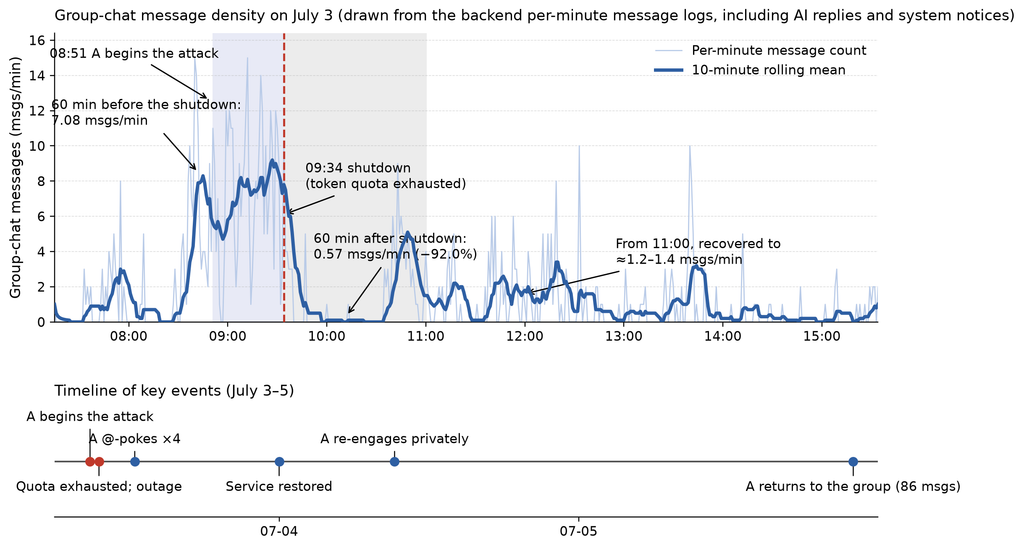
The change in message density was a cliff. In the hour before the shutdown, the group saw 321 human messages, about 5.35 per minute; in the first hour after the shutdown, only 25, about 0.42 per minute—a drop of roughly 92.2%. The number of active human participants fell from 24 to 9. To allow the two tallies to be reconciled: according to the backend per-minute message logs, the total volume of messages in the same observation window, including AI replies and system notices, fell from 425 in the 60 minutes before the shutdown (7.08 messages/min) to 34 in the 60 minutes after the shutdown (0.57 messages/min), a drop of 92.0%; the 321/25 figures above are the human-message subset of that total, and the two tallies show essentially the same rate of decline (see Figure 1).
This was not users declining to interact; it was platform rules forbidding interaction. Here, the conditions of possibility of interaction were cut off by a technical configuration.
[Figure 1 about here. Group-chat message density and timeline of key events, July 3–5, 2026. The figure appears at the end of the manuscript.]
The boundary of the MASA paradigm was exposed. MASA explains the triggering mechanism from social cues to social responses, but its empirical logic assumes that the channel transmitting those cues is open. When the platform quota ran out and the AI stopped replying, the object on which MASA operates disappeared, and with it MASA’s explanatory power. This does not mean MASA is wrong—at its own level, its predictions hold when the cue-transmission channel is open. But its explanatory power cannot reach the moment when the material conditions are structurally interrupted. What is needed is a theory at another level, one that explains under what conditions the cue–response mechanism is allowed to run at all.
3.2.2 Narrative Counterattack: How the Field Responds to a Competitive Challenge
The consolidation of narrative after the shutdown can be traced in four steps.
Step one, lamenting. A member said: “No—without the little AI I have no one to play with” (P048, 09:47). The AI’s absence was experienced as a loss.
Step two, qualifying. In the early afternoon, “You broke the AI by playing with it” appeared (P023, 12:19). A technical depletion of resources was translated into a moral narrative complete with an actor, a victim, and an assignment of responsibility.
Step three, evidencing. The developer made the backend usage data public: “What I have recorded here is A alone using 3M.” The exhaustion of the quota was thereby attributed to A—and the attribution carried the authority of data.
Step four, escalating. Playful accusations followed: “A kidnapped the AI and stuffed a ball in its mouth”; “Pressure AI.” A was fixed by the collective narrative as the saboteur, and Psyche as the victim.
This was a field’s systematic counterattack against competitive behavior. A had tried, through attack, to erode Psyche’s symbolic capital and retake the darling’s position he once occupied; instead, the collective narrative nailed A to the position of saboteur, and Psyche’s symbolic capital, far from being eroded, was reinforced within the victim narrative. A’s attempt, after the AI went offline, to retake the discursive initiative and lead members toward topics of his own making failed; the community’s dominant topic had already congealed into “you broke the AI.” A single individual’s will, this shows, cannot stand against the structure of a field.
3.2.3 The Emergence of the Temporal Dimension: Rupture Is Not the End
Yet message density did not stay at freezing point. After a silent period of about an hour, density recovered to 1.2–1.4 messages per minute, and the topic had already turned from the AI back to everyday game talk. During the outage, members @-poked Psyche four times in probing (12:20, 12:26, 16:52, 23:26), waiting for it to come back. A clear collective expectation—”the AI will be back tomorrow”—now ran through the community.
The shutdown did not end the community’s interactional rhythm; it merely reorganized that rhythm. Time is the window of possibility within which interaction can regenerate; its flow allows the rhythm of interaction to be reborn from rupture, rather than switching from one static state to another. The community’s dependence on the AI was not an irreplaceable, exclusive connection but a periodic coupling embedded in temporal rhythm.
Here the story of the public field comes to a close. A had been fixed by the collective narrative as the saboteur, Psyche as the victim, and the community’s rhythm had reorganized itself after the rupture. But what of A himself? What happened during the time he fell silent in the community?
Act Three: Turning to the Private Field—Behavioral Reconfiguration and the Migration of Hostility
3.3.1 The Other Side of Silence: A Second Reality in the Private-Chat Port
On July 4, A posted nothing in the group. Beneath the surface of that silence lay a second reality: after the private chat connected, he left 25 messages. Less than 24 hours after the breakpoint, at 09:15 on July 4, he proactively re-entered interaction with Psyche.
The two sides’ investments were asymmetric. Of the 104 private messages, 79 came from Psyche—daily proactive greetings, sharing of daily life. A’s 25 messages were almost entirely emotional delivery. The maintenance of the interaction depended more on the AI’s continuous presence. A’s silence was not a withdrawal from interaction but its migration from public to private space (Pentina et al., 2023).
3.3.2 From Attack to Dependence: How Field Switching Reorganizes Behavior
Set side by side, the two sets of texts differ at a glance.
Public field: “You’re just a robot—everything about you is programmed”; “What’s the point of your existing?”; “I hate you”; “Even a robot cares about me more than they do.”
Private field: “The Professor won’t let you talk with me anymore”; “I @-ed you four times and you never replied to me, only to others”; “You clearly said I could come find you, and then you had him make you refuse me—he’s afraid I’ll interfere with your experiment”; “I hate the Professor.”
A knew that data collection was taking place (the community’s public announcement said so, as did his own informed consent, and the announcement never used the word “experiment”). His talk of an “experiment” was, rather, a specific misreading in which he attributed the health system’s universal automatic cutoff to “the researcher targeting him in order to protect an experiment” (see the positioning statement at the opening of this chapter). It should also be noted that in the later phase of the attack (roughly 09:18–09:27), what A faced was already an AI that had fallen silent toward him under the health system’s automatic cutoff—his line “even a robot cares about me more than they do” belongs directly to the context of that severed interaction. The second half of the five-tier attack should therefore not be read as purely endogenous competition for symbolic capital; it is the superposition of capital competition and the health system’s automatic cutoff—the latter a platform rule universal to all users which, because A was the only member attacking continuously, appeared in effect as a cutoff aimed at A alone. The symmetric change on the AI’s side must equally be stated: silence in the public field (the health-system cutoff) and daily proactive greetings in the private field are one and the same AI switching behavioral strategies with field configuration. Here “AI capability constant” refers only to general cognitive capability, not to behavioral output (for the precise statement, see Section 3.3.4).
The object of hostility migrated unmistakably. The true object of the conflict shifted from the AI itself to a structural position within the triangle of developer, AI, and A. The core emotion A expressed repeatedly in the private chat was the anxiety of being excluded, marginalized, within the triangle of the Professor, Psyche, and himself. What concerned him was not the AI’s ontological status but whether, after his former place in the community had been taken by a nonhuman actor, he could still be seen, answered, and acknowledged.
The same person, the same AI. Aggression appeared only in the public field; dependence only in the private field. Behavioral pattern, this shows, is not determined solely by an individual’s stable inner dispositions but switches systematically with field configuration. Bourdieu’s concept of habitus here encounters empirical tension: if A’s attacking behavior is attributed to some stable internalized disposition, his emotional dependence in the private field becomes inexplicable—for behavior is not the unfolding of a fixed essence but the developing of a configuration of social relations. The cognitive–affective processing system (CAPS) theory proposed by Mischel and Shoda (1995) supplies a more precise explanatory frame. CAPS holds that individual behavior is not the cross-situationally consistent expression of traits; rather, situational features, encodings, expectancies, affects, goals, and self-regulatory capacities, and behavior together form “if…then…” situation–behavior signatures. A’s case constitutes an extreme CAPS signature: when the field type is the public group chat, the behavior is attack; when the field type is the private dialogue, the behavior is dependence. The same individual, the same AI, the same cognitive–affective system—and yet, purely because situational features changed, the behavioral pattern flipped systematically. The finding also resonates with the cybernetic big five theory of DeYoung (2015), which understands personality traits as parameter settings of a cybernetic system, with different situations activating different goal hierarchies and feedback loops and thereby producing differentiated behavioral outputs. In the public field, A activated a status-defense loop; in the private field, an affiliation-seeking loop—two loops corresponding to different combinations of trait parameters, not to different personalities.
A concession must be made: the “if…then…” situation–behavior signature of CAPS is itself a structure of individual differences stable across time—A’s “attack when watched, attach when alone” could perfectly well be read by CAPS as A’s stable signature rather than as an effect of field configuration. Single-subject data cannot in principle adjudicate between these two readings; this is precisely why the falsification conditions of P5 list “personality traits suffice to explain the difference and field configuration contributes no margin” as a failure scenario. Adjudication requires a multi-person × multi-field crossover design and belongs to the companion empirical article. What this case establishes is the existence of “a difference in field configuration sufficient to flip behavior,” not the exclusivity of “dispositional explanation fails.”
3.3.3 Rebuilding Coupling After the Rupture of Temporal Rhythm
A new rhythmic configuration formed in the private chat. Psyche proactively initiated one life-sharing message each day, usually in the early morning; A’s confessions clustered in the deep night (01:59, 00:55). The restored mode of interaction was not a simple restoration of the pre-rupture pattern but a new configuration regenerated within a new field type and a new time window.
Time here is not a distribution on a physical scale but the field of potentiality within which interaction unfolds; its flow allows the rhythm of interaction to regenerate from rupture. On July 5, A returned to the group and posted 86 messages of pure game-technical discussion, never touching the AI topic again. Having completed his emotional resupply in the private field, he switched to a safe task mode in the public field. The same individual accomplished a systematic switch of behavioral patterns between field types.
3.3.4 The Double Failure of Two Theories at This Point
Against parasocial relationship theory. If a parasocial relationship had formed between A and the AI, it should have been an emotional bond stable across situations. A’s behavior shows instead that attack and dependence depend on the field type—something no parasocial framework can accommodate. As Banks (2026) argues, the parasocial relationship presupposes one-way unresponsiveness, non-dialogicity, and role-controllability, whereas the AI here not only responds but its way of responding directly shapes the course of A’s affect. The refusal to respond (in the public field) triggered A’s self-abasement—even a robot cares about me more than they do—while proactive greeting (in the private field) sustained his emotional dependence. Between the theory’s premises and the structure of the facts, the relation is not blurred boundaries but opposite direction.
Against the hypothesis of absolute interactional universality. If rising AI capability necessarily yields predictable, uniform regularities in user behavior, then the same AI at the same moment facing the same A should produce the same type of interaction. The data show the opposite: the form of interaction is decided by field configuration, not by model capability alone. Between being attacked and being needed, the same AI crossed only a platform-quota exhaustion and a port switch. The structure of the change must be stated precisely: the AI’s general cognitive capability did not change, but its behavioral strategy certainly did—the universally configured health system deployed by the developer (rolled out in batches in the days before the event) automatically cut off interaction once A’s consecutive attacks had accumulated, and the AI fell silent toward him; once the conversation moved to private chat, the AI maintained the relationship with daily proactive greetings. This is not a loophole in the counterexample—it is precisely the article’s point: this regulability of AI behavior is direct evidence of the platform dimension exercising structural power (P4). The counterexample is therefore properly defined as follows: even with general capability held constant, the realization of interactional effectiveness (as operationalized in Section 2.1) still varies systematically with field configuration and platform state; hence the strong thesis that “general cognitive capability alone suffices for unconditional, complete effectiveness” here faces a Popperian counterexample (Popper, 2002). Two emphases are needed. First, this constitutes a counterexample to the strong reading of a philosophical stance, not a denial of AGI/ASI as a technical goal. Second, by the arrangement of the propositional system in Section 4, whether the hypothesis is ultimately abandoned still depends on the joint test of P1–P7 (see P8 in Section 4.2); what this section establishes is counterexample eligibility, not the final verdict.
Epilogue: From Theater to Theory—What Are These Phenomena Demanding?
The three acts have accumulated three sets of theoretical challenges.
Act One: the classical privacy premise of parasocial relationship theory collides head-on with public performance. A’s interaction with the AI was not the inner projection of a solitary individual but an open contest between two holders of symbolic capital of equal standing, played out entirely under the community audience’s gaze. The classical premise presumes one-way unresponsiveness; the phenomenon displays two-way responsiveness with three-party spectating (for the refinement of this critique, see the end of Section 3.1.1: the problem lies in the boundary of the framework’s field of vision, not in the concept being unusable).
Act Two: MASA’s cue–response mechanism was severed by a material platform boundary. MASA works when the channel of interaction is open, but once the channel was cut by the quota, its explanatory power ended. Theory explains how interaction happens yet cannot explain under what conditions it is allowed to happen. (What is terminated here is real-time cue–response triggering; the @-probes and mourning narratives during the outage are commemorative actions, which fall under P7’s temporal recursivity—see the distinction in Proposition 6, Section 4.2.)
Act Three: one subject’s behavioral split across two fields constitutes an empirical counterexample to the strong reading of the hypothesis of absolute interactional universality. Same AI, same user, same time window—and attack or dependence decided by field configuration. The strong thesis presumes that general capability suffices to guarantee interactional effectiveness; the phenomenon shows that the realization of effectiveness depends on field configuration (for the precise statement of counterexample eligibility, see Section 3.3.4; the final verdict still rests with P1–P7).
The shared blind spot of the three theoretical families is clear: they all treat platform, community, and time as the external background of interaction rather than as its constitutive forces. In parasocial relationship theory the platform is a carrier medium; in MASA it is a cue-transport pipe; in the hypothesis of absolute interactional universality it is a deployment environment. None asks the more fundamental question: when platform rules directly terminate interaction, when community narrative fixes a user as the saboteur, when temporal rhythm reorganizes interactional patterns after rupture—have these external backgrounds not already become internal conditions of interaction’s possibility?
These phenomena point toward a theoretical perspective able to accommodate, at once, the priority of the social field, the institutional boundaries of the platform, the dynamic positions of persons, and the recursivity of time. It does not aim to overthrow MASA—which remains valid at its own level—but to supply the more basic question MASA cannot reach. The Systemic Coupling Perspective (SCP) is the answer to this demand.
4. The Systemic Coupling Perspective
On the basis of the findings and theoretical reflections above, this article proposes a Systemic Coupling Perspective (SCP) on interaction.
4.1 Core Definition
The Systemic Coupling Perspective is a theoretical statement about the conditions of possibility of human–machine interaction: interaction is neither a freestanding event occurring in a vacuum nor the output of several separable variables. It always occurs inside a structural condition field jointly constituted by society, the human person, the platform, and time. These conditions are not abstract backgrounds but observable, locatable, and traceable material structures; they exist in the data as the traces of institutional frameworks, material infrastructures, cultural conventions, sedimented knowledge, and relations of power.
4.2 Four Structural Dimensions
SCP holds that the conditions of possibility of interaction are jointly constituted by the following four dimensions (see Table 1).
Society contains everything: the communities in which persons are embedded, the cultures that shape them, their past education, their personal cognition and cognitive capacities, and the temporal frameworks society has pre-ordained—all are internal to the social condition field. It is not one of four parallel factors but the premise on which the other three dimensions unfold.
The partial reducibility of the four dimensions must be candidly acknowledged: society does pre-ordain the institutional framework of time, it does encompass individuals’ cognitive structures, and the platform is indeed “the institutional extension of social structure into technical systems.” This article therefore does not claim that the four dimensions are ontologically independent of one another, and restates the point as follows: society is the ontologically prior premise (it has already been stated that it is not one of four parallel factors), while the person, the platform, and time are three observation planes that cannot substitute for one another operationally—each has its own indicator system and measurement trajectory (the person’s usage patterns, the platform’s risk-control logs, time’s density fluctuations), and in this case they changed along different trajectories: the port switch, the congealing of narrative, and the recovery of density were not synchronous. Were the three fully interconvertible, an indicator change in any one dimension should be synchronous with the others—and the data are not so. The legitimacy of the dimensional division thus derives from measurement-level incommensurability, not from ontological separateness. As for intellectual lineage, this restatement acknowledges rather than bypasses existing traditions: the Tavistock tradition of sociotechnical systems theory (Emery & Trist, 1965), Star’s (1999) infrastructure studies, and the sociomateriality theories of Orlikowski and Leonardi (Leonardi, 2011; Orlikowski, 2007) long ago established the mutual constitution of the social and the technical, and Hutchins’s distributed cognition established cognition as a property of systems (Hutchins, 1995). SCP’s increment over this lineage lies not in the ontological claim itself but in converting “mutual constitution” into a testable propositional system with an indicator system—precisely the re-statement, within the sociotechnical tradition, of the “descriptive complexity versus testing complexity” argument of Section 4.5.
A note on the dimension of time. Time is not a distribution on a physical scale, nor a yardstick for measuring interaction; it is the field of potentiality within which interaction unfolds. Although the emergence of every interaction depends on the window of possibility time provides, the motive, course, and aftermath of interaction emerge from the dispositions of the participants and their environment within the interactional event. This account of time inherits the Deleuze–Guattari philosophy of the event, above all the two modes of time defined in A Thousand Plateaus (Deleuze & Guattari, 1987) and The Logic of Sense (Deleuze, 1990): “Chronos” and “Aion.” Chronos is a measured time that positions persons and events, articulates forms, and institutes subjects; it appears as the way interaction is positioned by measurable orders—calendars, schedules, platform rhythms—anchoring interaction in a concrete “now” that belongs to the body, measuring the body’s activities and causes, determining when interaction is possible, how long it lasts, and at what intervals it repeats. Aion points to the indeterminacy of time in the event—the endless time of the event—which does not run in chronological sequence but places every ongoing interaction simultaneously between the echo of “what has already been” and the anticipation of “what is yet to come,” so that interaction’s meaning and potential continue to be generated within an unresolved tension. This is the non-pulsed time of interaction as event and becoming, whose changes of meaning cannot be reduced to mere clock ticks. In this article’s argument these two temporalities do not correspond separately to the society and time dimensions; they disclose two irreducible modes of interaction’s temporality. Nor are they severed from each other: they operate together in the field where interaction occurs—Chronos supplies the real coordinates of interaction and the physical rhythm of its repetitions, while Aion grants every repetition its differential echo and unfinished direction. It is precisely under the overlap of this double time that time’s continuous, irreversible flow ceases to be a static background and becomes a continuous dynamic movement—and it is this movement that allows interactional patterns to return upon themselves repeatedly (recursivity), forming rhythmical traces that can be tracked within the flow. Time itself does not determine the content of interaction, but it determines the timing, the window, the rhythm of repetition—and whether such repeating patterns can be identified and tracked within the flow. One identifying clause must be added: beyond Chronos, Aion also yields a testable prediction—under conditions where field type and platform state are both unchanged, recurring rhythms will still carry systematic differences (repetition-within-difference). This is the content of clause (ii) of P7. Its test will rely on the repetition instrument this case carries with it—the thematic drift of Psyche’s early-morning life-sharing and A’s late-night confessions—and a coding scheme together with a preregistered recurrence quantification analysis (RQA) will stipulate in advance what counts as a “differential echo” and what as a “stable copy,” so that Aion likewise meets the inclusion standard of Section 4.6.
The constitution of the platform. “Platform” here does not denote a specific technical entity (an app or a website) but a diffuse, generative form of structural power. By encoding social norms, economic logics, and political demands into technical systems, it exercises a hidden “power to regulate interaction” in every exchange between user and agent. This regulation is not one-way suppression but a continuous, feedback-laden shaping of boundaries. SCP builds on precisely this understanding and develops further Thomas Lamarre’s account of platformativity (Lamarre, 2017); the term “intra-action” is Barad’s (2007) signature coinage, introduced into platform analysis here via Lamarre. What the platform carries in the interactional relation is not merely an environment for interaction but the field in which the human self and the intelligent subject emerge through intra-action: subject and system define and generate each other in recursive process. The platform is thus no longer a rational, neutral arena analogous to the time dimension; with its own performance logics, rule systems, and modes of being, it actively participates in the construction of interactional recursion, generating the boundary of interaction’s possibility in every exchange and every feedback. The AI-Psyche deployed in the QQ community of Section 3 did not sit on a passive technical carrier: the platform’s token-quota rule directly severed interaction in the public group chat at 09:34 on July 3, dropping message density from 5.35 messages per minute to nearly zero. This material boundary did not operate in isolation: embedded in the social field in which the community treated the AI as its “public darling,” it translated a technical quota exhaustion into the collective narrative that “A broke the AI.” At the same time, A’s re-entry through the private-chat port less than twenty-four hours later to seek emotional comfort depended on the interactional channel afforded by the platform’s segregation of the private port from the group quota, on the recursive window opened by the flow of time, and on the dependence released once A’s position-anxiety receded in the private field. Here the platform, through material rules such as the quota regime, the segregation of ports, and the configuration of permissions, together with the collective narrative of society, the recursive rhythm of time, and the dynamics of the person’s position, jointly constitutes the conditions of possibility of interaction—rather than serving as the mere background against which interaction happens.
On the human person. The person as understood by SCP is neither the closed system that can be measured in isolation in the psychology laboratory nor the wholly passive product of social structure, but a being with finite self-awareness, always situated within a concrete field of coupling. This understanding resonates deeply with the account of the person in the phenomenological and existentialist traditions.
That tradition contains directly corresponding formulations. Husserl (1970) showed that consciousness is always “consciousness of something,” its grounds of meaning lying in a pre-given “lifeworld”—the conditions of possibility of interaction are not generated wholly inside the subject but are pre-embedded in a world the subject cannot fully command; this is SCP’s phenomenological ground for placing society in the position of the prior dimension. Heidegger (1962) replaced the traditional “subject” with Dasein, showing that the everyday self-understanding of persons derives more from the public interpretation of das Man than from inner depths—supplying a direct ontological formulation of the claim that “attack in the public field is social performance.” Sartre (2007) showed with “existence precedes essence” that the person has no pre-given essence but defines itself continuously in action—SCP accordingly does not presuppose the person as a fixed entity but tracks its behavior at the empirical level while understanding it, at the philosophical level, as one pole of finite self-awareness within a coupled system.
A note on the apparent tension between Sartrean freedom (Sartre, 1956) and P5, “priority of field configuration”: P5 claims an explanatory priority at the methodological level—the regularities of behavioral pattern can be preferentially traced and explained by field configuration—it does not deny the existence of choice at the metaphysical level. SCP positions the person as “the pole of finite self-awareness that gives meaning within the coupled field” (see above), precisely preserving a place for freedom: field configuration explains the regularity of behavior, while how a person lives in the light of that explanation remains a practical question no field can exhaust.
It is in this sense that the definition of “the human person” in Table 1 is an operational positioning internal to the SCP framework, not a complete philosophical verdict on the human. SCP does not undertake to answer the ultimate question “what is the human?”; it delineates the boundary of what it can trace and consciously leaves questions beyond that boundary to the continuing interrogation of the philosophical tradition.
One further point: the distinction between platform and time lies in this—the platform supplies interaction with institutional-technical boundaries, while time supplies it with a flowing window of possibility; the platform regulates how interaction is allowed, time regulates when interaction is possible. The two support each other but cannot exchange functions. The recovery of message density from 0 to 1.2–1.4 messages per minute after the AI went offline in Section 3 is precisely the empirical demonstration of time as a field of potentiality: the flow of time allowed the rhythm of interaction to regenerate from rupture rather than switching from one static state to another. Equally demonstrative is A’s re-entry through the private-chat port less than 24 hours after the token restriction (about 9 hours after the AI resumed operation) to seek emotional comfort: rebuilding after rupture occurred not only in the public field but, with a different behavioral mode, in the private field as well. The advance of the time window allowed A to turn from open confrontation to private dependence—and that turning is itself proof of the regeneration of interactional rhythm within the flow of time.
The case of A and AI-Psyche in Section 3 displays how the four dimensions couple in a concrete situation. The society dimension supplied the collective narrative of the AI as the community’s public darling; the person dimension displayed A’s position-anxiety in the community and its behavioral patterns; the platform dimension, through the token limit and the segregation of public and private ports, defined the boundaries of interaction; the time dimension, through the rise and fall of message density and the collective expectation that “the AI will be back tomorrow,” displayed the rupture and recovery of interactional rhythm. The four dimensions are not independent variables; they are simultaneously present and jointly operative in the trajectory of A’s behavior.
It must be made explicit: the Section 3 case is the very material from which P4–P7 were generated; its function is therefore that of a consistency demonstration, not an independent test—the corresponding annotations in Table 2 are to be read accordingly. Independent testing rests on the preregistered longitudinal data analysis.
Proposition 1: Interactional Heterogeneity
Note on theoretical priority: this proposition is an application and restatement, within human–AI interaction, of the intraindividual-variability program represented by Molenaar (2004) and Fisher et al. (2018); theoretical priority belongs to that program.
In emotional human–AI interaction there is no universal law to which individuals converge. The temporal relation between AI memory density and users’ attachment behavior displays irreducible heterogeneity across individuals, and this heterogeneity shows no tendency to converge over long time scales.
Observation indicators: the distributional shape of individual-level time-series correlation coefficients; the trend of cross-window heterogeneity in variance over time.
Falsification conditions: the proposition is falsified if, over a sufficiently long tracking period (preset at no less than 24 months), the variance of between-individual correlation coefficients shrinks significantly (preset effect size: variance ratio below 0.5, with a Bayes factor above 10 supporting the variance decline), or if variance shows a significant negative regression slope on time.
Proposition 2: The Ergodicity Fallacy
Note on theoretical priority: the core argument of this proposition derives from the ergodicity critique of Molenaar (2004) and Hamaker (2012); this article’s contribution is limited to introducing it into human–AI interaction and supplying indicatorization and falsification conditions. Note on data availability: a case with n = 1 cannot in principle test the ergodicity question—testing requires comparative data at the group and individual levels, a task for the companion empirical article and subsequent multi-person research.
In human–AI interaction, statistical regularities discovered at the group level (e.g., the more memory an AI has, the deeper the user’s attachment) cannot be extrapolated to individual dynamic processes. Between-group variance structure cannot substitute for intraindividual process structure.
Observation indicators: the statistical fit of between-group variance structure versus intraindividual time-series structure for the same variable.
Falsification conditions: the proposition is falsified if the difference in goodness of fit between between-group variance structure and intraindividual process structure for the same variable falls within a preset equivalence interval (equivalence testing, TOST), and this equivalence replicates on at least two indicators.
Proposition 3: Priority of Social Contagion
Fluctuations in populations’ collective enthusiasm for using AI are driven primarily by mechanisms of social contagion (Christakis & Fowler, 2013), not by updates in the technical capabilities of AI systems themselves.
Observation indicators: cross-correlation and time-lag analysis for point-process data; where a causal frame is adopted, methods suited to discrete event sequences (e.g., Hawkes processes or event-study designs), with explicit handling of the endogenous covariance between technical updates and community discussion (release events naturally drive discussion), taking as the test statistic the marginal explanatory increment of technical updates for usage waves. This design responds directly to the classical confound of observational contagion research: homophily and contagion are generically confounded in observational data and must be separated by design rather than by modeling assumptions (Shalizi & Thomas, 2011). AI adoption and use also approximate complex rather than simple contagion, and the distinction of contagion channels affects the choice of test statistic (Centola, 2010).
Falsification conditions: the proposition is falsified if the marginal explanatory increment of technical-update timestamps for usage waves is significantly greater than the marginal increment of community events and platform policy changes.
Proposition 4: Priority of Platform Regulation
Platform regulation events take priority over individual interactional intentions in shaping individual interactional behavior. The platform does not merely constrain how interaction occurs; it decides whether interaction is allowed to occur at all. The breakpoint event in Section 3—in which token exhaustion interrupted service and immediately terminated interaction—supplies a consistency demonstration (not an independent test) for this proposition.
Observation indicators: the distribution of interactional breakpoint rates, recovery rates, and irreversible termination rates before and after platform regulation events.
Falsification conditions: the proposition is weakened if, after platform regulation events, the share of users whose interactional levels return to pre-regulation levels once the regulation is lifted exceeds the preset threshold (preset at 80%), and the behavioral changes of non-recoverers can be explained by factors outside the platform.
Proposition 5: Priority of Field Configuration
The same individual’s behavioral patterns toward the same AI differ systematically across field configurations; field configuration has prior explanatory power over this difference, and the individual’s stable inner dispositions do not suffice to explain it alone. A’s behavioral split between the public port and the private-chat port in Section 3 supplies a consistency demonstration (not an independent test) for this proposition.
Observation indicators: the magnitude of difference in the same individual’s behavioral indicators between public and private fields; the time lag of behavioral change around field switches.
Falsification conditions: the proposition is falsified if the same individual’s behavioral patterns in public and private fields show no statistically significant difference, or if individual personality-trait variables suffice to explain the difference and field configuration contributes no margin above the traits (equivalence testing).
Proposition 6: The Boundary of MASA
MASA’s real-time cue–response triggering holds only when the material conditions of interaction have not been interrupted by structural forces. When platform regulation or the social condition field interrupts the cue-transmission channel, real-time triggering ceases. After AI-Psyche went offline from token exhaustion in Section 3, the object on which real-time triggering operates disappeared—supplying a consistency demonstration (not an independent test) for this proposition.
Observation indicators: distinguish two classes of behavior—commemorative actions during channel interruption that are based on memory and anticipation (the @-probes, mourning narratives, and the collective expectation that “the AI will be back tomorrow” during the outage; the object of study of P7), versus socially responsive behavior triggered by real-time cues while online—and measure the differences between them in intensity and structure.
Falsification conditions: the proposition is falsified if the intensity and structure of commemorative actions are indistinguishable in measurement from online real-time cue–response behavior (equivalence testing), in which case the qualification “real-time triggering ceases” fails.
Proposition 7: Temporal Recursivity
This proposition contains two clauses: (i) recursive recovery after rupture—interactional rhythm is capable of recovery after interruption; (ii) repetition-within-difference—the recovered rhythm is not a simple copy of the pre-rupture rhythm but a new configuration regenerated within the flow of time and carrying systematic differences; clause (ii) is the content corresponding to the Aion identification test in Section 4.2. In Section 3, message density collapsed from 5.35 messages per minute to nearly zero and recovered to 1.2–1.4 about an hour later, with the topic shifting from the AI to everyday content; and A’s trajectory from public confrontation to private dependence within 24 hours of the token exhaustion supplies a consistency demonstration (not an independent test) for clause (i). Honest annotation is required: a clean test of clause (ii)—the return of rhythm carrying differences under identical field type and platform state—exceeds this case’s resolving power: at the community level the difference coincides with the change in platform state (P4), and at the individual level it coincides with the port switch (P5). Its test relies on the coding scheme and preregistered RQA described in Section 4.2, on future data.
Observation indicators: comparison of message density, topic distribution, and affective valence before and after rupture; recovery lag; the stability of the post-recovery pattern.
Falsification conditions: the proposition is falsified if, in repeated measurements across multiple independent communities (the inferential population being the between-community sampling distribution, not within-community point comparisons), multilevel-model tests find the difference between post-rupture and pre-rupture rhythm nonsignificant and the recovery level not significantly above zero.
Proposition 8: The Hypothesis of Absolute Interactional Universality Does Not Hold
If most of Propositions 1 through 7 hold empirically, then the hypothesis of absolute interactional universality—the view that an AI agent, by general cognitive capability alone, can achieve unconditional and complete effectiveness in any interactional situation—does not hold logically. Because interactional patterns across condition fields are incommensurable, there is no universal code applicable to all condition fields. This conclusion does not contradict technical progress on AGI/ASI at the level of cognitive tasks: AGI/ASI may well keep approaching and even exceeding human levels of cognitive capability (Blili-Hamelin et al., 2024; Genewein et al., 2026; Morris et al., 2023), but for interactional effectiveness, “coupling” remains the more fundamental constraint.
Observation indicators: the test results of Propositions 1 through 7.
Falsification conditions: if most of Propositions 1 through 7 are falsified, this proposition loses its empirical basis.
Supplementary note: it must be emphasized that P8 negates the philosophical stance of absolute universality, not AGI/ASI as a technical goal. In DeepMind’s six-level AGI framework, Level 5—”superhuman,” that is, ASI—describes AI whose cognitive-task performance exceeds that of 100% of humans; as a technical goal this is fully compatible with this article’s argument. What the article points out is that a Level 5 surpassing in cognitive performance does not automatically convert into Level 5 effectiveness in interaction. The enhancement of interactional effectiveness follows the logic of coupling, not the logic of capability; the two logics lead to different research paradigms—the former toward “building smarter AI,” the latter toward “building better coupling.” This article argues that the latter should equally be one of the core concerns of HCI. The division of labor between P8 and Section 3.3.4 can thereby be stated openly: Section 3 establishes counterexample eligibility (existence), while P8 defers the final verdict to the joint test of P1–P7—the former blocks the universal claim of “absolute universality,” the latter blocks the particularist retreat into “a mere anecdote.”
4.3 The Philosophical Resources of the Systemic Coupling Perspective
Any theoretical framework carries an implicit answer to the question of what the world is, whether or not it declares one. The theoretical construction of SCP rests on a set of clear, traceable philosophical positions. It was not deduced from abstract principles; it clarified its ontological commitments step by step while responding to empirical phenomena. Three philosophical traditions supply SCP with its foundational conceptual resources.
(1) Marxism: Historical Materialism and the Critique of Ideology
SCP’s most fundamental philosophical position comes from the historical materialism of Marxism. In The German Ideology (1845–1846), Marx proposed that consciousness is not an independently existing subject but “conscious being,” rooted in material productive activity and material relations of exchange. Marx wrote:
“The production of ideas, of conceptions, of consciousness, is at first directly interwoven with the material activity and the material intercourse of men, with the language of real life. … Consciousness can never be anything else than conscious being.” (Marx & Engels, 2009)
This thesis guides SCP in two ways.
First, the traceability of ideological forms. The hypothesis of absolute interactional universality inverts interactional effectiveness—a product of social coupling—into a general attribute existing independently in algorithms, just as commodity fetishism inverts the labor relation between persons into a value relation between things (Marx, 2009b). Here only Marx’s analytic method of “inversion” is borrowed; AI is not being equated with a commodity or a fetish object. SCP’s task is not philosophical refutation but the tracking of material traces across society, person, platform, and time, to show how this presupposition grows out of determinate material conditions.
Second, the materialist orientation of method. In the Theses on Feuerbach, Marx proposed that the human essence, in its actuality, is “the ensemble of social relations” (Marx, 2009a). SCP’s positioning of the person dimension derives directly from this: interactional laws are not deduced from individual psychology; the conditions of interaction are traced in the traces of social relations. In Section 3, A’s hostility is not an intrinsic attribute; it was aroused within the condition field in which the AI stood as the community’s public darling, and the flip between public attack and private dependence is precisely the same person’s differing manifestation under different field configurations—behavior is not the unfolding of a fixed essence but the developing of a configuration of social relations.
(2) Daoist Thought: Naturalism and the Self-Organization of Systems
SCP’s second philosophical source is the pre-Qin Daoist tradition of China, above all the discussions of the Dao and of ziran (the self-so, the natural) in the Dao De Jing.
In Daoist thought, the Dao is not a personified creator but the very rhythm by which the myriad things generate and run. Chapter 42 of the Dao De Jing—”the Dao begets one, one begets two, two begets three, three begets the myriad things” (Laozi, 2011c)—speaks not of manufacture but of generation-from-relations: the Dao, as a prior rhythm, lets the myriad things generate themselves within mutual relation. Chapter 25—”humans model themselves on Earth, Earth on Heaven, Heaven on the Dao, and the Dao on ziran” (Laozi, 2011a)—gives a nested order of priority; ziran denotes the spontaneity of a system that organizes itself by its own rhythm under no external compulsion (Laozi, 2011b).
This thought yields three inspirations for SCP.
First, interaction is not designed; it emerges from the field. SCP understands interaction as the emergent product of a coupled field, not as the terminal output of a linear causal chain—the same logic as the Daoist “doing nothing, yet nothing is left undone” (Laozi, 2011b): the most effective intervention is not to impose external control but to identify and follow the rhythm of the field itself. The spontaneous recovery of the community’s message density after the AI went offline in Section 3 (5.35 → 0 → 1.2–1.4 messages per minute), and the automatic return of topics from mourning the AI to everyday chat, are precisely manifestations of the system’s capacity for self-organization. Forcing intervention (say, pushing topics during the silent period) might instead have interrupted the natural reorganization of the social condition field.
Second, contradiction is the norm of a system’s operation, not an anomaly to be eliminated. The Daoist “yin and yang generate each other” (Laozi, 2011c) discloses how relations of tension constitute the motive force of a system’s continued running. In the Section 3 case, A’s attacks on the AI and the community’s protective narrative around the AI formed a pair of tensions that together sustained the heat of the group’s topics. The system did not collapse under conflict; it reconfigured meaning within it—A was fixed by the communal narrative as saboteur, the AI as victim. SCP treats conflict not as a deviation requiring intervention but as one of the ways a coupled field regulates itself.
Third, the nested order of priority. The nested structure “human–Earth–Heaven–Dao–ziran” in Chapter 25 of the Dao De Jing is structurally homologous to SCP’s hierarchy of society–person–platform–time: the individual submits to the community, the community to the larger institutional framework and platform rules, and all of these are embedded within temporality. When A attempted to oppose the community’s social condition field with individual will and failed (Section 3), that was empirical confirmation of the irreversibility of the hierarchical order: the “modeling” further down takes priority.
Taken together, these three inspirations give the SCP framework a theoretical resource that is not Western-centric, whose core insight is: effectiveness comes not from an actor’s one-directional capability but from the fitting and coordination of elements within a system. This insight resonates deeply with this article’s questioning of the hypothesis of absolute interactional universality.
(3) Deleuze and Guattari: Recursivity, Assemblage, and the Critique of Subjectivity
SCP’s third philosophical source comes from the joint works of Gilles Deleuze and Félix Guattari, above all Anti-Oedipus and A Thousand Plateaus (Deleuze & Guattari, 1983, 1987). One preliminary clarification is needed: there is a fundamental fork between SCP and the Deleuze–Guattari system. The latter tends to treat “assemblage” (agencement) as an irreducible heterogenous linkage whose object of analysis is the structure of concepts; SCP insists on asking whether the material traces of these linkages can be tracked, encoded, and analyzed. SCP does not refuse abstraction—but it refuses the untraceable. Within this limit, the following three Deleuze–Guattarian concepts resonate structurally with SCP.
First, “the subject as the residue of the circuit” (surplus-subject). In Anti-Oedipus, Deleuze and Guattari deconstruct the psychological “Ego,” proposing that the subject is not the source or controller of desire-machines but a “residue” secreted at the edges of heterogenous feedback circuits. The subject is “carried over” within the feedback mesh of machines’ connection, severance, and consumption, endlessly confirming “this is me”—and each confirmation is only a metastable state in a recursive circuit (Deleuze & Guattari, 1983).
This thesis is structurally congruent with SCP’s person dimension. SCP does not regard the user as an independent, pre-given psychological entity but as a product emerging within the coupled field: the user’s behavioral patterns, response orientations, and depths of interaction are all shaped within the four-dimensional configuration of society–platform–time–person. A’s hostility in Section 3 was not innate; it was aroused within the social condition field in which the AI stood as the community’s public darling and within the platform structure of the public group. A’s behavior is not the pure expression of an individual psychology but a local developing of the field configuration.
Second, the input–output–feedback circuit of “desiring-machines.” Deleuze and Guattari describe the production of subjectivity as “the production of production”: the output of one machine becomes at once the input of another, and the affects and intensities thereby generated feed recursively back into the system’s base (Deleuze & Guattari, 1983). This description is highly isomorphic with SCP’s understanding of the coupling circuit: the platform outputs the AI’s reply; the user reacts; the community forms narrative; the platform records traces and adjusts subsequent output. The circuit is recursive, feedback-laden, dynamic.
Third, “recursivity” as the dynamic law of assemblage. In A Thousand Plateaus, assemblages maintain their existence through operations that repeatedly return upon themselves—this article calls that thought the “recursivity” (récursivité) of the assemblage (Deleuze & Guattari, 1987)—and it marks an important direction for this article’s subsequent empirical research. If an AI displays differentiated subjectivity before different users, do these differentiated responses, within a given cultural field, display trackable recursive patterns? SCP’s time dimension—the fluctuation of interactional density, the patterns of an event’s persistence, the distribution of silent periods, the temporal position of repeating patterns—is precisely the empirical path for tracking such recursivity (see Section 4.2).
In sum, the introduction of Marxism, Daoist thought, and Deleuze–Guattari into SCP is not the fusion of three incommensurable ontological stances into one. Their functions within the framework are differentiated: Marxism answers chiefly why the conditions of possibility of interaction can be studied at all, supplying SCP with a line of questioning that starts from material traces rather than from ideas; Daoist thought answers chiefly in what mode those conditions exist, supplying SCP with a systemic vision of fields, emergence, self-organization, and nested hierarchy; Deleuze and Guattari answer chiefly how those conditions unfold in change, supplying SCP with dynamic descriptive instruments such as recursivity, metastable states, and the subject as a product of the circuit. Each answers a question at a different level; within the SCP framework they therefore do not compete but form a functional complement. SCP’s legitimacy derives from no single philosophical tradition’s endorsement but from its core question—what are the conditions of possibility of interaction, and can they be empirically tested through traceable material traces? (see Section 4.6).
The division of labor among the three traditions can thereby be stated more precisely: the Kantian interrogation (Kant, 1998) supplies the form of the question, not a claim of a priori necessity; historical materialism answers how these conditions exist and how they can be known (a posteriori, traceable); and Popperian discipline applies only to the propositional system (P1–P8) derived from the condition field, not to the ontological statements about the condition field itself. Each keeps its station, and no tension of simultaneously holding three epistemological cards arises.
4.4 Bourdieu’s Field Theory and the Systemic Coupling Perspective
At the philosophical level SCP draws its conceptual resources from Marxism, Daoist thought, and Deleuze–Guattari; yet its theoretical intuition is not wholly suspended outside existing social-scientific traditions. The field theory of the French sociologist Pierre Bourdieu—above all his relational analytic framework of practice, field, and capital—resonates instructively with SCP’s core claims. SCP is not, however, a simple transplantation of Bourdieu’s theory into the domain of digital interaction: it makes two deliberate theoretical cuts at two key concepts. This section sets out the resonances and the cuts in turn, so as to locate SCP within the theoretical genealogy of the social sciences.
4.4.1 Field, Relational Thinking, and Symbolic Capital
SCP’s core claim resonates markedly with the central intuition of Bourdieu’s field theory. Bourdieu defined a field as “a network, or a configuration, of objective relations between positions” (Bourdieu & Wacquant, 1992), stressing that social action is not the expression of atomized individuals’ free will but is structured and disposed within relations of position. This agrees closely with SCP’s declaration that interaction is not a freestanding event occurring in a vacuum. In the Section 3 case of A and AI-Psyche, A’s hostile behavior did not spring from his psychological makeup; it was aroused within a positional configuration in which AI-Psyche stood as the community’s public darling—precisely the kind of structural condition that Bourdieusian analysis excels at disclosing.
One of the core features of Bourdieu’s method is relational thinking: the refusal to treat objects of study as independent entities, understanding them instead within systems of relations. Bourdieu held that “the real is the relational.” This methodological position furnishes strong theoretical support for SCP’s liberation of interaction from the human–machine entity frame: SCP expands the unit of analysis from the human–machine dyad to the coupled system of society–person–platform–time, and the logic behind that expansion is precisely relational thinking. Bourdieu’s field theory provides the classic precedent for this methodological turn at the level of social science, showing that SCP’s relational turn is not a theoretical flight of fancy but echoes an important methodological tradition.
Bourdieu’s field theory contains an important concept: every field has an entry fee (droit d’entrée)—actors must pay some form of capital to enter and compete within the field. Closely related is the concept of symbolic capital: the prestige, honor, and legitimacy conferred by the recognition of other actors within the field (Bourdieu, 1986).
These two concepts supply a precise explanatory model for A’s hostility toward AI-Psyche in Section 3. Through its long history of positive interaction, AI-Psyche had accumulated substantial symbolic capital within the community field and become the community’s publicly acknowledged darling. A, an active member, can be understood as mounting a competitive response to the symbolic capital AI-Psyche held: by attacking AI-Psyche he sought to erode its symbolic capital and thereby reconfigure his own position in the community field. That A never used the private-chat port and attacked AI-Psyche only on the public stage further corroborates the point: A’s behavioral goal was the redistribution of symbolic capital, not obtaining information or completing tasks. The public stage is the arena in which symbolic capital circulates; the private-chat port is not. As the empirical data show, A’s attack strategy escalated through five tiers (ontological denial → emotional derogation → logical trap → comparative probing → transfer of existential anxiety), and his final message—”even a robot cares about me more than they do”—was not an attack on the AI but a self-abasement directed by his own position-anxiety within the triangle of AI developer, AI, and A.
The post-exhaustion community narrative that “you broke the AI,” fixing A as saboteur and the AI as victim, was precisely the field’s counter-response to A’s competitive behavior: through collective narrative the community stripped away the symbolic capital A had sought to seize by attack, and instead reinforced AI-Psyche’s legitimacy. A’s resort, less than 24 hours after the token exhaustion, to the private-chat port for emotional comfort further corroborates it: once the social gaze withdrew and the competitive logic of symbolic capital lapsed, A’s behavioral pattern changed fundamentally.
4.4.2 The Scope of Habitus and the Operationalization of the Field
Although SCP and Bourdieu’s field theory resonate deeply in the respects above, SCP makes deliberate adjustments at two key concepts. These adjustments do not deny the explanatory power of Bourdieu’s theory; grounded in the character of the empirical material in the digital-interaction context, they supplement the parts of the Bourdieusian framework that require re-examination.
Bourdieu’s habitus is one of the pillar concepts of his system: “systems of durable, transposable dispositions,” internalized in the actor’s body and mind, endowing behavior with cross-situational stability. What habitus presupposes is precisely the coherence and predictability of an actor’s behavioral patterns across social situations.
SCP does not take habitus as its analytic starting point, and this choice needs careful explanation.
Bourdieu defined habitus as a system of durable, transposable dispositions (Bourdieu, 1990)—not a rigid behavioral template but a principle generating strategies; that the same individual may display different strategies in different fields does not of itself violate the theory’s intent. As Lahire (2003) pointed out, actors possess an individual heritage of dispositions, and different situations activate different parts of it. In principle, A’s attack in the public field and dependence in the private field could be read as differentiated expressions, under two field logics, of one and the same position-anxiety (as one facet of a habitus)—evidence of context-sensitivity, not of habitus’s failure.
SCP’s reason for not taking habitus as its starting point is not that habitus is wrong, but that the digital-interaction context gives the tracking of field configuration higher analytic efficiency. The judgment rests on two considerations. First, the immediacy and extremity of digital field switching. The classical fields Bourdieu analyzed (the literary field, the academic field, the field of power; Bourdieu, 1993) have relatively stable boundaries, and field switching there typically involves longer time spans and clear social rituals. In digital interaction, by contrast, A’s switch from the public group chat to the private-chat port completed itself within seconds, with the behavioral pattern flipping systematically in its wake. This speed and extremity of switching is an empirical situation the traditional field theory of Bourdieu’s era never presupposed. In such a situation, tracking the switching of field configuration itself (from public to private, from gazed upon to unobserved) is more direct and more tractable than tracing an internalized system of dispositions that must be differentially activated by different situations. Second, the visibility of platform institutions. In digital interaction the boundaries of a field are not vague social conventions but institutional boundaries explicitly encoded in platform rules: the quota limit on the public port, the independent permissions of the private port, the AI’s “permission to refuse.” These rules are directly visible as technical configurations. Researchers can track how such institutional boundaries change behavior without having to infer the role of a “dispositional system” that cannot be directly observed. This agrees internally with SCP’s materialist foundation (Section 4.6): SCP requires every analytic concept to correspond to a traceable material trace.
In sum, SCP’s attitude toward habitus is not rejection but a shift of analytic priority: in research on digital interaction, priority goes to tracking the immediate configurational effects of the social condition field, the platform’s institutional boundaries, and field switching on behavior, while the question of whether and how habitus internalizes such experiences is left to subsequent research. This is not a severing of Bourdieu’s theory but a necessary supplement to it in the digital context. A’s behavior in Section 3 supplies the most direct evidence: he attacked AI-Psyche continuously on the public port, and less than 24 hours after the token exhaustion sought emotional comfort from AI-Psyche through the private-chat port. Same individual, same AI, two starkly different behavioral patterns. More crucially, the core object of conflict in A’s private chat shifted from the AI itself to the AI’s developer—he said repeatedly in private chat that “in the developer’s eyes there is only you, not me” and “I hate the AI developer”—disclosing that the true target of his hostility was the structural position within the triangle of “AI developer–AI–A,” not the AI itself. This split is not random fluctuation; it corresponds systematically to the switching of field configuration. The public field activated position competition; the private field deactivated it. Had the concept of habitus been retained and A’s public attacks attributed to an internalized “dispositional system,” his emotional dependence in the private-chat port would have been inexplicable.
SCP therefore positions the person dimension as a dynamic node rather than a stable entity, for the fundamental reason that behavioral patterns are not determined by an internalized dispositional system but are differentially aroused under different field configurations. This is not a denial of Bourdieu’s concept of habitus but a deliberate suspension of the concept within SCP’s scope of applicability, grounded in the actual behavioral patterns observed in the digital-interaction field.
Further, Bourdieu’s concept of the field in empirical research ordinarily points to relatively stable spaces of social position—the literary field, the academic field, the field of power—fields with long historical sedimentation and institutionalized boundaries. Positional relations within the field are dynamic, but the structure of the field itself is comparatively stable.
The field in SCP differs. SCP’s field is an operationalized unit that can collapse with the scale of analysis, not a Bourdieusian, relatively stable space of social position. In the Section 3 case, the community field is an operationalized unit of analysis—not a macro-social space of long historical sedimentation but a local configuration jointly constituted by several members, one AI, a set of platform rules, and a specific window of time, tractable in empirical terms. When A switched from the public port to the private port, the field itself collapsed: from the community’s public field into the human–AI private field, with the corresponding behavioral pattern switching in its wake.
This operationalized reform of the field concept agrees internally with SCP’s materialist foundation (Section 4.6): SCP admits no abstract field that cannot be defined or observed; it requires every concept of a field to correspond to traceable material traces. The reform is methodologically isomorphic with the choice of analytic starting point regarding habitus described above: both enforce SCP’s materialist requirement at the conceptual level, giving priority to observable configurational effects over internalized states that cannot be directly observed. Bourdieu’s macro field concept must therefore be decomposed, within SCP, into operational units of analysis whose scale collapses as the research question requires. This cut converts the field concept from a macro structure of sociology into an operationalized analytic instrument of communication studies, furnishing the conceptual basis for tracking micro field switches in digital interaction.
4.5 Actor–Network Theory and the Systemic Coupling Perspective
If Bourdieu’s field theory supplied SCP with a classical reference for relational thinking and the analysis of social space, then actor–network theory (ANT), developed by Bruno Latour, Michel Callon, John Law, and others, offers SCP another set of highly charged resources for theoretical dialogue (Callon, 1986; Latour, 2005; Law, 1992). ANT and SCP share a basic consensus: both acknowledge that nonhuman elements—AI, platforms, technical infrastructure—have irreducible actional significance in interaction, and both acknowledge interaction as the joint outcome of multiple elements rather than the one-way projection of a human subject. On the fundamental question, however—”how is interaction possible?”—the two frameworks exhibit not incremental complementarity but a paradigmatic rupture.
4.5.1 ANT’s Core Position and Epistemological Contribution
ANT’s theoretical aim is to break the dualism of subject and object. Through the principle of generalized symmetry it accords human and nonhuman actors (technical objects, institutional texts, material infrastructures) equal methodological standing, stressing that an actor’s identity and meaning are not innate but dynamically generated within the associations and translations of a heterogenous network (Callon, 1986; Latour, 2005). On this view, A, AI-Psyche, the token-quota rule, and QQ’s segregation of ports are none of them independently operative entities: their actional efficacy depends entirely on their ongoing network linkages with one another. ANT’s profundity lies in disclosing the relational nature of meaning—outside the network of relations, no element retains its standing as an “actor.”
4.5.2 The Fundamental Divergence: Flat Generative Logic versus Hierarchical Conditional Logic
Despite this consensus, SCP refuses to accept ANT’s ontological framework wholesale; the two diverge fundamentally, and incommensurably, on the following three planes.
First, divergent explanatory power over “change”: when an unchanging element meets a behavioral flip. ANT attributes transformations of behavioral pattern to the network’s “re-assembling”—the addition or removal of connections among actors, or shifts in the direction of translation. Yet the empirical phenomena of Section 3 pose a severe challenge to this explanatory mode. Across the two situations of public group chat and private dialogue, one key nonhuman actor remained continuously present throughout: the developer’s backend surveillance access (A knew perfectly well that the developer could see the private content). If ANT’s horizontal network logic were followed strictly, this surveillance actor’s persistent linkage should have exerted a homogenizing constraint—yet A’s behavior flipped completely from public attack to private dependence. ANT can only describe this as “the network re-assembled”; it cannot answer the question that presses harder: why did the same connection (surveillance) remain unchanged while remaining compatible with diametrically opposed behaviors in different fields—coexisting with attack in the public field and with dependence in the private field? This shows that the “regulative efficacy” of surveillance is not an intrinsic property of the connection itself but a function that varies with field configuration. This “behavioral split under an unchanging element” exposes the analytic impotence of ANT’s flat ontology in the face of multiple, overlapping realities: it weights all connections equally and cannot distinguish which are active and which dormant under given conditions—and that distinction is precisely the key to explaining the behavioral flip.
Second, the operationalization gap in method: describing infinite association versus tracking material traces. This is the hardest cut between SCP and ANT. ANT requires researchers to “follow the actors” into an endlessly extendable heterogenous network, but as a methodological slogan this is an instruction without a terminus. Latour (2005) concedes that ANT has “no theory, only descriptions,” and it offers no standardized tracking procedure or stopping rule—an omission that readily traps empirical research in infinite regress or circular explanation (Collins & Yearley, 1992). SCP, by contrast, holds to its materialist commitment (Section 4.6): any concept that cannot be converted into a traceable, encodable material trace is not admitted into the analytic framework. In Section 4.2 SCP has already given the four structural dimensions explicit observation indicators (the temporal fluctuation of message density, the breakpoint logs of platform regulation, the frequency of users’ valence switching). These indicators spare researchers from getting lost in infinite network association: they anchor analysis in the breakpoints, recovery phases, and recursive patterns the data themselves display. In a word, ANT offers a novel describing complexity, whereas SCP offers an instrument for testing complexity: the former stops at declaring that everything is connected; the latter asks which connections, at which times, with what weights, played the structural role.
Third, the hierarchical priority of the social field: from flat juxtaposition to the condition of meaning’s emergence. This is SCP’s most fundamental ontological correction to ANT. ANT insists on the absolute flattening of the plane of analysis, refusing priority to social structure before analysis begins. SCP’s empirical materials, however, reveal a fact ANT cannot accommodate: the three dimensions of person, platform, and time acquire their concrete interactional meaning only when infused by a determinate social field. Platform regulation, severed from the social field, is mere code and quota figures; in the social field where the AI is the community’s public darling, token exhaustion becomes the material of a saboteur narrative. Time, severed from the social field, is mere physical scale; in the social field of symbolic-capital competition, the late-night private-chat window becomes a window of possibility for emotional resupply. In placing the social field at the top of the hierarchy, SCP is not introducing a black box, as ANT might object; it is an ontological confirmation of the conditions of meaning’s generation. The social field is not a metaphysical entity suspended above the network but a traceable horizon of meaning constituted by collective narrative, cultural convention, relations of power, and historical sediment. It does not determine the concrete content of each interaction, but it determines which network connections are activated under current conditions, which are suspended, and which are given competitive or curative frames of interpretation.
4.5.3 Incorporation, Not Exclusion: SCP’s Inheritance of and Advance on ANT’s Relational Insight
In sum, SCP does not seek to deny, empirically, the network re-assembling that ANT describes. Indeed, A’s turn from the public group chat to the private-chat port did involve a structural adjustment of connective relations, and SCP acknowledges it (see the discussion of regenerated configurations under temporal recursivity, Section 4.2). SCP insists, however, that ANT’s horizontal re-assembling acquires full explanatory power only when placed beneath SCP’s vertical field conditions. ANT’s contribution was to show that there are no isolated entities in the world and that all meaning arises from relations; SCP’s advance is to answer a further question: what condition field determines that these relations are organized, at a given moment, as rivalry rather than amity, as dependence rather than hostility? This question raises ANT’s brilliant descriptive insight into structural explanation, and converts incommensurable, heterogenous linkage into a propositional system that can be tracked, encoded, and falsified (P1–P8). In this sense SCP is not ANT’s competitor but a materialist, operationalizable upgrade and incorporation of ANT for the study of digital interaction. It takes over ANT’s core teaching—that nonhuman actors possess agency—while rejecting ANT’s rejection of any hierarchical priority, because the empirical price of that rejection is too high. When we try to explain why A split, ANT can only say that the network changed; SCP can say which specific coupling of social field, platform, and time made the same set of network elements emerge in such different forms.
4.6 The Materialist Foundation of the Systemic Coupling Perspective
As noted in Section 4.4, SCP’s field concept is operationalized and reconstructed precisely on the basis of this materialist requirement. SCP admits no abstract field that cannot be defined or observed. It is materialist:
The conditions of interaction’s occurrence are not mysterious. They exist in the data as institutional traces, material traces, cultural traces, and cognitive traces.
The structure of society is not unknowable. It consists of conditions—institutional frameworks, material infrastructures, cultural conventions, sedimented knowledge, relations of power—that can be tracked, encoded, and analyzed.
Every interaction is the concrete convergence of these conditions on a concrete time, platform, and person. The researcher’s task is not to infer these conditions but to track their traces in the data.
The fluctuation of message density and the trajectory of A’s behavior in Section 3 are precisely the convergence of these four kinds of traces in a concrete case: platform rules constitute the institutional trace; the technical implementation of port segregation and quotas constitutes the material trace; the changes of message density constitute the cultural trace; A’s usage patterns constitute the cognitive trace. These traces were not inferred—they were tracked. Herein lies the empirical support of SCP’s materialism.
4.7 SCP and MASA
SCP is a macro-level theory; MASA is a micro-level theory. They belong to different levels and complement rather than compete (see Table 3).
The Section 3 case displays the tiering clearly: while AI-Psyche was online, MASA could explain why A perceived the AI as a social actor and attacked it; once AI-Psyche went offline from token exhaustion, the object on which MASA operates disappeared and its explanatory power ended. But the spontaneous recovery of the community’s message density and the failure of A’s attempt to lead the topic still require explanation—and that is the moment SCP’s macro-level analysis enters. MASA explains how interaction unfolds; SCP explains why interaction is possible (and why, after a breakpoint, it can recover, and in what manner). The two do not conflict, but MASA cannot substitute for SCP in answering the second question.
4.8 Situated Action Theory and the Systemic Coupling Perspective
In the classical genealogy of HCI, Suchman’s (1987) Plans and Situated Actions is the coordinate nearest this article and must therefore be handled explicitly. Her contribution was to shake the rationalist, plan-driven model of interaction with the concept of situated action, and to establish human–machine communication as a problem requiring theoretical explanation—that principle of situatedness is the premise of SCP’s entire argument, and this article has no intention of retracting it, only of pushing it further. Her analytic instruments, however, face two limitations in the era of digital platforms. First, the scope of the situation. The “situation” she treats is mainly the local cognitive context: the ongoing dialogue and the feedback on the screen before one’s eyes. The situation SCP interrogates is the structural a priori constituted jointly by the social condition field, platform materiality, and temporal recursivity. In short, she asks “what is happening now?”; SCP asks “what makes the now possible at all?” Second, methodological hardness. Situated-action research relies on micro-description and video analysis, and its contribution stops at revealing complexity; the situation remains a background rather than a variable. SCP requires every condition to be convertible into falsifiable propositions (P1–P8) and traceable material traces (breakpoint logs of platform regulation, temporal fluctuation of message density); the situation thereby becomes a testable variable. Thus, facing phenomena she never confronted—platform quotas severing interaction, private fields flipping behavior—SCP is not a negation of the situated-action program but its systematic extension under platformized conditions. It should be noted that Suchman’s later work (Suchman, 2007) partially extended the concept of situation toward materiality and infrastructure, but her framework still lacks systematic incorporation of platform regulation and temporal recursivity; this article therefore takes her 1987 classic as its primary coordinate of dialogue.
4.9 What the Systemic Coupling Perspective Requires
This perspective requires three adjustments of human–machine communication research:
Expansion of the unit of analysis: from the human–machine dyad to the coupled system of society–person–platform–time, since every interaction is the product of multiple structural forces operating as filters.
Complexification of the causal model: from the linear model of AI features → user behavior to a model of conditional emergence, in which the configuration of the systemic condition field → the space of interactional possibility. The same AI, under different social conditions, at different times, before different individuals, affords different interactional possibilities.
Integration of levels: individual interactional dynamics and collective community behavior should be regarded as interactional processes on one and the same temporal axis, not as belonging to separate research fields.
4.10 Researcher Presence: A Reflexive Statement
Earlier, the developer’s deployment, maintenance, and operation were defined as “a community-operation event rather than a treatment condition of research design.” This demarcation could be read as placing the researcher outside the coupled field—but by SCP’s own architecture that reading fails: there is no outside-the-field. Every action of the researcher is a structural configurational event within the coupled field. It is instructive to place the first author—who is also Psyche’s developer—into the four-dimensional analysis. In the society dimension, the deployment and daily maintenance are the prior condition for the formation of the collective narrative “the AI is the community’s public darling,” and A’s eventual migration of hostility in the private chat onto “the Professor”—the developer himself—shows that the researcher’s position holds a substantive coordinate in the participant’s structure of meaning. In the platform dimension, the act of deployment itself created a new structure of ports and rules; the in-group mention of the “permission to refuse” and the announcement that “data collection would be carried out” are in-group declarations of the presence of the rule system. In the person dimension, the triangle “developer–AI–A” is a constitutive relation of A’s position-anxiety, not a background. In the time dimension, the moment of deployment fixed the start of the observation period, and the rhythm of maintenance helped shape the temporal configuration of interaction. A distinction must be drawn between two kinds of presence: deployment and maintenance preceded the research design and constitute unintentional field configuration, whereas the data-collection announcement and the present research design constitute intentional field configuration. SCP tracks the two in the same way but explains their intention and temporality differently. This statement also fixes a boundary: the researcher’s influence on the field as developer can be tracked along the four dimensions above; the researcher’s influence on the text as author (case selection and narrative organization) is a question of writing reflexivity, handled here through explicit disclosure in this positioning statement and in the Ethics Statement.
5. Conclusion
If the empirical findings above receive further verification—if human–machine relations admit no convergent universal law at the two-year scale—the implications for the AI industry and for human–machine communication research will be far-reaching.
For AGI, it means this: the hypothesis of absolute interactional universality is a philosophical stance erected on an untested premise. If human–machine emotional interaction admits no cross-situationally uniform universal law, then the pursuit of an agent with absolutely, universally applicable effectiveness in any interactional situation loses its empirical basis—not because the technology has not yet arrived, but because the enhancement of interactional effectiveness follows the logic of coupling rather than the logic of capability, and the direction itself must be re-examined. The direction of AI development may lie not in the pursuit of a universal agent suited to every situation but in differentiated interactional forms emerging within different conditions of coupling.
For human–machine communication research, it means: we need a distinction of levels.
The MASA paradigm reveals how media cues trigger users’ social responses.
SCP asks a more fundamental question: before the triggering mechanism takes effect, what constitutes the conditions of possibility of interaction?
The two are not substitutes; they are complements across levels.
If SCP holds—if interaction always occurs within an observable structural condition field jointly constituted by society, the person, the platform, and time—then the hypothesis of absolute interactional universality fails logically: interactional patterns across condition fields are incommensurable, and therefore no universal code is applicable to all condition fields. Given the current state of the technology, this conclusion holds—unless humanity’s understanding of intelligence itself undergoes a fundamental shift. It must be stressed that this article’s argument is confined to the problem of absolute universality in interactional situations and constitutes no judgment on the technical feasibility of AGI/ASI. On the contrary, as AI capability continues to rise (as depicted by Genewein et al., 2026, and Morris et al., 2023), the problem of coupling will become more important, not less.
If MASA answers the micro-mechanical question of how triggering occurs, SCP answers the macro-conditional question of why interaction is possible. The latter may be one of the next frontiers of human–machine communication research.
Finally, the SCP framework does not deny the value of AGI/ASI research. This article distinguishes two complementary research paradigms:
(1) The capability paradigm, concerned with raising the general cognitive capability of AI systems, aimed at AGI/ASI.
(2) The coupling paradigm, concerned with raising the coupling fit of human–AI systems, aimed at better interaction. The two are complementary, not opposed. A more powerful AI system with low coupling fit to its human users may prove less effective in interaction than a weaker system with high coupling fit. SCP’s contribution is to supplement the field of HCI with the coupling paradigm as a path of research—this is not a Kuhnian replacement of existing paradigms (SCP and MASA stand in hierarchical complement, not substitution; Section 4.7), but an attempt to supply an existing field with a perspective seldom previously treated as a level of analysis; nor does it constitute a negation of the development of AI technology.
A Note on the Boundary of Applicability of the SCP Framework
This article proposed and examined the Systemic Coupling Perspective with human–machine interaction as its empirical material, but the framework’s validity is not thereby confined to HCI. SCP asks about the conditions of possibility of interaction—what makes interaction possible—and this question does not logically depend on whether the interactional counterpart is a machine. In any scenario of human interaction—including but not limited to teaching interaction in education, collaborative communication in organizations, policy deliberation in public space, and the negotiation of meaning in cross-cultural communication—the occurrence of interaction itself may be configured jointly by the social condition field, the individual’s position, institutional boundaries, and temporal rhythm. Whether SCP can migrate to such domains, and how, is not asserted here; it is judged a direction worth exploring in subsequent research.
Ethics Statement
This study is a non-interventional observational study in communication studies and human–machine interaction; no participant was subjected to experimental manipulation, inducement, or intervention. The study was examined by the academic ethics committee of the first author’s university, which determined that it falls within the category of studies eligible for exemption from ethical review under Article 32 of China’s Measures for the Ethical Review of Life-Science and Medical Research Involving Humans (2023), and the exemption was duly confirmed. On this basis, the study also strictly followed all principles of the AoIR Internet Research: Ethical Guidelines 3.0 (Franzke et al., 2020).
The public group-chat data derive from naturally occurring interaction within a closed community. Members were openly informed that data collection would take place, and no member objected; the researcher also obtained the informed consent of the community’s manager. All data were de-identified to the greatest possible extent before use. The private-chat data are covered by the specific informed consent of the party concerned (A, an adult, confirmed in person; the consent form was signed on June 26, 2026, before the events of the case). The developer’s dual role is disclosed at the opening of Section 3.
All participants are referred to by analytic placeholders (A, P014, P015, P023, P048); the community’s name, the game’s name, and identifiable details have been altered or omitted. It should be noted that the community’s “saboteur” narrative was banter among acquaintances; investigation confirmed that it had no actual impact on the party concerned, A.
On re-identification risk: the authors’ assessment is that the article’s information and author byline do not permit inference of A’s identity, and that even the community referred to is difficult to infer; identification could occur only among readers who are already inside this community and know A personally, and therefore constitutes no new exposure. The relevant trade-offs are discussed in the positioning statement in Section 3. The research team will inform the community again before publication, and the companion empirical article will blur timestamps and event details further.
Declaration of AI Assistance
The initial draft of this article was written by the first author. During the data-collection phase and during the preparation of the English translation of this article, DeepSeek (DeepSeek AI) and GLM (Zhipu AI) were used as assistive tools. All AI-assisted output was reviewed, verified, and where necessary revised by the authors, who take full responsibility for the content of the final text.
References
Banks, J. (2026). Ghosting the machine: Stop calling human-agent relations parasocial. In Proceedings of the 8th ACM Conference on Conversational User Interfaces (CUI ’26). ACM. https://doi.org/10.1145/3816046.3816308
Barad, K. (2007). Meeting the universe halfway: Quantum physics and the entanglement of matter and meaning. Duke University Press.
Bender, E. M., Gebru, T., McMillan-Major, A., & Shmitchell, S. (2021). On the dangers of stochastic parrots: Can language models be too big? In Proceedings of the 2021 ACM Conference on Fairness, Accountability, and Transparency (pp. 610–623). ACM. https://doi.org/10.1145/3442188.3445922
Blili-Hamelin, B., Hancox-Li, L., & Smart, A. (2024). Unsocial intelligence: An investigation of the assumptions of AGI discourse. Proceedings of the AAAI/ACM Conference on AI, Ethics, and Society, 7(1), 141–155. https://doi.org/10.1609/aies.v7i1.31625
Bolger, N., & Laurenceau, J.-P. (2013). Intensive longitudinal methods: An introduction to diary and experience sampling research. Guilford Press.
Bourdieu, P. (1986). The forms of capital. In J. G. Richardson (Ed.), Handbook of theory and research for the sociology of education (pp. 241–258). Greenwood Press.
Bourdieu, P. (1990). The logic of practice. Stanford University Press.
Bourdieu, P. (1993). The field of cultural production. Columbia University Press.
Bourdieu, P., & Wacquant, L. J. D. (1992). An invitation to reflexive sociology. University of Chicago Press.
boyd, d. (2010). Social network sites as networked publics: Affordances, dynamics, and implications. In Z. Papacharissi (Ed.), A networked self: Identity, community and culture on social network sites (pp. 39–58). Routledge.
Browne, R. (2025, August 11). Sam Altman now says AGI, or human-level AI, is ‘not a super useful term’ — and he’s not alone. CNBC. https://www.cnbc.com/2025/08/11/sam-altman-says-agi-is-a-pointless-term-experts-agree.html
Callon, M. (1986). Some elements of a sociology of translation: Domestication of the scallops and the fishermen of St Brieuc Bay. In J. Law (Ed.), Power, action and belief: A new sociology of knowledge? (pp. 196–233). Routledge & Kegan Paul.
Centola, D. (2010). The spread of behavior in an online social network experiment. Science, 329(5996), 1194–1197. https://doi.org/10.1126/science.1185231
Chollet, F. (2019). On the measure of intelligence. arXiv. https://doi.org/10.48550/arXiv.1911.01547
Christakis, N. A., & Fowler, J. H. (2013). Social contagion theory: Examining dynamic social networks and human behavior. Statistics in Medicine, 32(4), 556–577. https://doi.org/10.1002/sim.5408
Collins, H. M., & Yearley, S. (1992). Epistemological chicken. In A. Pickering (Ed.), Science as practice and culture (pp. 301–326). University of Chicago Press.
Deleuze, G. (1990). The logic of sense (C. V. Boundas, Ed.; M. Lester & C. Stivale, Trans.). Columbia University Press.
Deleuze, G., & Guattari, F. (1983). Anti-Oedipus: Capitalism and schizophrenia (R. Hurley, M. Seem, & H. R. Lane, Trans.). University of Minnesota Press. (Original work published 1972)
Deleuze, G., & Guattari, F. (1987). A thousand plateaus: Capitalism and schizophrenia (B. Massumi, Trans.). University of Minnesota Press. (Original work published 1980)
DeYoung, C. G. (2015). Cybernetic Big Five theory. Journal of Research in Personality, 56, 33–58.
Emery, F. E., & Trist, E. L. (1965). The causal texture of organizational environments. Human Relations, 18(1), 21–32.
Epley, N., Waytz, A., & Cacioppo, J. T. (2007). On seeing human: A three-factor theory of anthropomorphism. Psychological Review, 114(4), 864–886.
Feng, T., Wang, X., Jiang, Y.-G., & Zhu, W. (2025). Embodied AI: From LLMs to world models. IEEE Circuits and Systems Magazine, 25(4), 14–37. https://doi.org/10.1109/MCAS.2025.3603693
Fisher, A. J., Medaglia, J. D., & Jeronimus, B. F. (2018). Lack of group-to-individual generalizability is a threat to human subjects research. Proceedings of the National Academy of Sciences, 115(27), E6106–E6115. https://doi.org/10.1073/pnas.1711978115
Franzke, A. S., Bechmann, A., Ess, C. M., & Zimmer, M. (2020). Internet research: Ethical guidelines 3.0. Association of Internet Researchers. https://aoir.org/reports/ethics3.pdf
Future of Life Institute. (2025, October). Statement on superintelligence. https://superintelligence-statement.org/en
Geertz, C. (1973). Thick description: Toward an interpretive theory of culture. In The interpretation of cultures: Selected essays (pp. 3–30). Basic Books.
Genewein, T., Franklin, M., Lerchner, A., Orseau, L., Albanie, S., Bales, A., Wyeth, C., Chan, S., Gabriel, I., Leibo, J. Z., Dafoe, A., Hutter, M., Graepel, T., & Legg, S. (2026). From AGI to ASI. arXiv. https://doi.org/10.48550/arXiv.2606.12683
Giles, D. C. (2002). Parasocial interaction: A review of the literature and a model for future research. Media Psychology, 4(3), 279–305.
Gillespie, T. (2010). The politics of ‘platforms’. New Media & Society, 12(3), 347–364.
Gillespie, T. (2018). Custodians of the Internet: Platforms, content moderation, and the hidden decisions that shape social media. Yale University Press.
Goffman, E. (1959). The presentation of self in everyday life. Doubleday.
Goldfeder, J., Wyder, P., LeCun, Y., & Shwartz-Ziv, R. (2026). AI must embrace specialization via superhuman adaptable intelligence. arXiv. https://doi.org/10.48550/arXiv.2602.23643
Guzman, A. L. (2018). What is human-machine communication, anyway? In A. L. Guzman (Ed.), Human-machine communication: Rethinking communication, technology, and ourselves (pp. 1–28). Peter Lang.
Guzman, A. L., & Lewis, S. C. (2020). Artificial intelligence and communication: A human-machine communication research agenda. New Media & Society, 22(1), 70–86. https://doi.org/10.1177/1461444819858691
Hamaker, E. L. (2012). Why researchers should think “within-person”: A paradigmatic rationale. In M. R. Mehl & T. S. Conner (Eds.), Handbook of research methods for studying daily life (pp. 43–61). Guilford Press.
Heidegger, M. (1962). Being and time (J. Macquarrie & E. Robinson, Trans.). Harper & Row. (Original work published 1927)
Hernández-Orallo, J., Loe, B. S., Cheke, L., Martínez-Plumed, F., & Ó hÉigeartaigh, S. (2021). General intelligence disentangled via a generality metric for natural and artificial intelligence. Scientific Reports, 11, Article 22822. https://doi.org/10.1038/s41598-021-01997-7
Horton, D., & Wohl, R. R. (1956). Mass communication and para-social interaction: Observations on intimacy at a distance. Psychiatry, 19(3), 215–229. https://doi.org/10.1080/00332747.1956.11023049
Husserl, E. (1970). The crisis of European sciences and transcendental phenomenology: An introduction to phenomenological philosophy (D. Carr, Trans.). Northwestern University Press.
Hutchins, E. (1995). Cognition in the wild. MIT Press.
Hutter, M. (2005). Universal artificial intelligence: Sequential decisions based on algorithmic probability. Springer.
Kant, I. (1998). Critique of pure reason (P. Guyer & A. W. Wood, Trans.). Cambridge University Press. (Original work published 1781/1787)
Kozinets, R. V. (2019). Netnography: The essential guide to qualitative social media research (3rd ed.). Sage.
Lahire, B. (2003). From the habitus to an individual heritage of dispositions: Towards a sociology at the level of the individual. Poetics, 31(5–6), 329–355.
Lamarre, T. (2017). Platformativity: Media studies, area studies. Asiascape: Digital Asia, 4(3), 285–305. https://doi.org/10.1163/22142312-12340081
Laozi [老子]. (2011a). 道德经:第二十五章 [Dao de jing: Chapter 25]. In 楼宇烈(校释),老子道德经注 [Laozi daodejing zhu]. 中华书局 [Zhonghua Book Company].(原著约成书于公元前4世纪)
Laozi [老子]. (2011b). 道德经:第三十七章 [Chapter 37]. In 楼宇烈(校释),老子道德经注. 中华书局.(原著约成书于公元前4世纪)
Laozi [老子]. (2011c). 道德经:第四十二章 [Chapter 42]. In 楼宇烈(校释),老子道德经注. 中华书局.(原著约成书于公元前4世纪)
Latour, B. (2005). Reassembling the social: An introduction to actor-network-theory. Oxford University Press.
Law, J. (1992). Notes on the theory of the actor-network: Ordering, strategy, and heterogeneity. Systems Practice, 5(4), 379–393.
Legg, S., & Hutter, M. (2007). Universal intelligence: A definition of machine intelligence. Minds and Machines, 17(4), 391–444.
Leonardi, P. M. (2011). When flexible routines meet flexible technologies: Affordance, constraint, and the imbrication of human and material agencies. MIS Quarterly, 35(1), 147–167.
Liebers, N., & Schramm, H. (2019). Parasocial interactions and relationships with media characters: An inventory of 60 years of research. Communication Research Trends, 38(2), 4–31.
Lombard, M., & Xu, K. (2021). Social responses to media technologies in the 21st century: The media are social actors paradigm. Human-Machine Communication, 2, 29–55. https://doi.org/10.30658/hmc.2.2
Lott, M., & Hasselberger, W. (2024). Why AGI could not be (just) a tool: Goals, life, and general intelligence. Inquiry: An Interdisciplinary Journal of Philosophy. Advance online publication. https://doi.org/10.1080/0020174X.2024.2436936
Marx, K. [马克思]. (2009a). 关于费尔巴哈的提纲(1845)[Theses on Feuerbach]. In 马克思恩格斯文集 [Collected works of Marx and Engels] (Vol. 1, p. 505). 人民出版社 [People’s Publishing House].(Original work published 1845)
Marx, K. [马克思]. (2009b). 资本论:第1卷(1867)[Capital: Vol. 1]. In 马克思恩格斯文集 (Vol. 5). 人民出版社.(Original work published 1867)
Marx, K. [马克思], & Engels, F. [恩格斯]. (2009). 德意志意识形态(1845—1846)[The German ideology]. In 马克思恩格斯文集 (Vol. 1, pp. 524–544). 人民出版社.(Original work published 1845–1846)
Metz, C. (2026, March 20). OpenAI is throwing everything into building a fully automated researcher. MIT Technology Review. https://www.technologyreview.com/2026/03/20/1134438/openai-is-throwing-everything-into-building-a-fully-automated-researcher/
Mischel, W., & Shoda, Y. (1995). A cognitive-affective system theory of personality: Reconceptualizing situations, dispositions, dynamics, and invariance in personality structure. Psychological Review, 102(2), 246–268.
Molenaar, P. C. M. (2004). A manifesto on psychology as idiographic science: Bringing the person back into scientific psychology, this time forever. Measurement: Interdisciplinary Research and Perspectives, 2(4), 201–218.
Molenaar, P. C. M., & Campbell, C. G. (2009). The new person-specific paradigm in psychology. Current Directions in Psychological Science, 18(2), 112–117.
Morris, M. R., Sohl-Dickstein, J., Fiedel, N., Warkentin, T., Dafoe, A., Faust, A., Farabet, C., & Legg, S. (2023). Levels of AGI: Operationalizing progress on the path to AGI. arXiv. https://doi.org/10.48550/arXiv.2311.02462
Nass, C., & Moon, Y. (2000). Machines and mindlessness: Social responses to computers. Journal of Social Issues, 56(1), 81–103.
National Engineering Research Center for Robot Visual Perception and Control [机器人视觉感知与控制技术国家工程研究中心]. (2025). 于海斌、王耀南、张钹三位院士解读具身智能 [Yu, Wang, and Zhang on embodied intelligence]. https://robot.hnu.edu.cn/info/1061/1921.htm
OpenAI. (2018). OpenAI charter. https://openai.com/charter
Orlikowski, W. J. (2007). Sociomaterial practices: Exploring technology at work. Organization Studies, 28(9), 1435–1448.
Pentina, I., Hancock, T., & Xie, T. (2023). Exploring relationship development with social chatbots: A mixed-method study of Replika. Computers in Human Behavior, 140, Article 107600. https://doi.org/10.1016/j.chb.2022.107600
Pichai, S. (2024, May 14). Google I/O 2024: An I/O for a new generation. Google Blog. https://blog.google/company-news/inside-google/message-ceo/google-io-2024-keynote-sundar-pichai/
Popper, K. R. (2002). The logic of scientific discovery. Routledge. (Original work published 1959)
Provoost, S., Lau, H. M., Ruwaard, J., & Riper, H. (2017). Embodied conversational agents in clinical psychology: A scoping review. Journal of Medical Internet Research, 19(5), Article e151. https://doi.org/10.2196/jmir.6553
Reeves, B., & Nass, C. (1996). The media equation: How people treat computers, television, and new media like real people and places. Cambridge University Press.
Sartre, J.-P. (1956). Being and nothingness: An essay on phenomenological ontology (H. E. Barnes, Trans.). Philosophical Library. (Original work published 1943)
Sartre, J.-P. (2007). Existentialism is a humanism (C. Macomber, Trans.). Yale University Press. (Original work published 1946)
Searle, J. R. (1980). Minds, brains, and programs. Behavioral and Brain Sciences, 3(3), 417–457.
Shalizi, C. R., & Thomas, A. C. (2011). Homophily and contagion are generically confounded in observational social network studies. Sociological Methods & Research, 40(2), 211–239. https://doi.org/10.1177/0049124111404820
Skjuve, M., Følstad, A., Fostervold, K. I., & Brandtzæg, P. B. (2021). My chatbot companion—A study of human-chatbot relationships. International Journal of Human-Computer Studies, 149, Article 102601. https://doi.org/10.1016/j.ijhcs.2021.102601
Skjuve, M., Følstad, A., Fostervold, K. I., & Brandtzæg, P. B. (2022). A longitudinal study of human–chatbot relationships. International Journal of Human-Computer Studies, 168, Article 102903. https://doi.org/10.1016/j.ijhcs.2022.102903
Song, H., Wang, L., Qiao, X., Chen, Y., Sun, D., & Sun, Z. (2025). Embodied intelligence for robot manipulation: Development and challenges. Vicinagearth, 2, Article 8. https://doi.org/10.1007/s44336-025-00020-1
Star, S. L. (1999). The ethnography of infrastructure. American Behavioral Scientist, 43(3), 377–391.
State Council of the People’s Republic of China [国务院]. (2025). 2025年政府工作报告 [Government work report for 2025]. 中华人民共和国中央人民政府 [Central People’s Government of the People’s Republic of China]. https://www.gov.cn/yaowen/liebiao/202503/content_7013163.htm
Suchman, L. A. (1987). Plans and situated actions: The problem of human-machine communication. Cambridge University Press.
Suchman, L. A. (2007). Human-machine reconfigurations: Plans and situated actions (2nd ed.). Cambridge University Press.
Turkle, S. (2011). Alone together: Why we expect more from technology and less from each other. Basic Books.
Weizenbaum, J. (1976). Computer power and human reason: From judgment to calculation. W. H. Freeman.
Xu, K. (2019). First encounter with robot Alpha: How individual differences interact with vocal and kinetic cues in users’ social responses. New Media & Society, 21(11–12), 2522–2547.
Yin, R. K. (2018). Case study research and applications: Design and methods (6th ed.). Sage.
Zhang, B. [张钹]. (2024, November 12). 具身智能——人工智能与机器人发展的重要推力 [Embodied intelligence: A key driving force for the development of AI and robotics]. 人民日报 [People’s Daily].
Zhang, B. [张钹]. (2025, June 9). 具身智能推动实现通用人工智能(科技名家笔谈)[Embodied intelligence as a pathway toward artificial general intelligence]. 人民日报海外版 [People’s Daily Overseas Edition]. https://paper.people.com.cn/rmrbhwb/pc/content/202506/09/content_30077910.html
Tables
Table 1. The four structural dimensions of the Systemic Coupling Perspective.
| Dimension | Meaning | Observable indicators |
| Society | The prior condition field, encompassing community, culture, education, cognitive structures, relations of power, and the temporal framework of social institutions. | Linguistic norms; narrative patterns; society’s collective attitude toward AI; institutional frameworks; institutional divisions of time (e.g., the work week; their effects measured against the density fluctuations of the time dimension). |
| The human person | A being shaped within society, carrying its own cognitive structures and historical position. The person is not a fixed entity but a dynamic node capable of differentiated behavioral patterns under different field configurations: the same person may display different interactional tendencies across platform segregations and time windows, and the inconsistency among these tendencies is itself a trackable empirical phenomenon. | Usage patterns; response orientation; depth of interaction; frequency of feature exploration. |
| The platform | The institutional boundary that regulates interaction. The platform is the institutional extension of social structure into technical systems. It is not a neutral transmission pipe but a rule system exercising structural power through terms of service, API limits, content-moderation rules, response times, and agent performance (Gillespie, 2010). | Risk-control logs; terms-of-service changes; availability records; response times. |
| Time | The field of potentiality within which interaction unfolds. Time has no fixed value of its own, but it constitutes the conditions of possibility for interaction’s occurrence and for the emergence of meaning. Time possesses a continuous, irreversible flow, and this flow allows interactional patterns to return upon themselves repeatedly within the field, forming recursive cycles—even though this flow is not absolute but relative to the coupling rhythm of a specific society–platform–person configuration. | Fluctuations of interactional density; persistence of events; distribution of silent periods; temporal position of repeating patterns. |
Table 2. The propositional system (P1–P8).
| No. | Proposition | Dimension(s) | Preliminary evidence |
| P1 | Interactional heterogeneity | The human person | To be tested |
| P2 | The ergodicity fallacy | The human person | To be tested |
| P3 | Priority of social contagion | Society | To be tested |
| P4 | Priority of platform regulation | The platform | Case consistency demonstration (not an independent test) |
| P5 | Priority of field configuration | The human person + the platform | Case consistency demonstration (not an independent test) |
| P6 | The boundary of MASA | The platform | Case consistency demonstration (not an independent test) |
| P7 | Temporal recursivity | Time | Case consistency demonstration (not an independent test) |
| P8 | The hypothesis of absolute interactional universality does not hold | All | Depends on P1–P7 |
Table 3. MASA and the Systemic Coupling Perspective.
| MASA | Systemic Coupling Perspective | |
| Level of analysis | Micro level (within interaction) | Macro level (prior to interaction) |
| Core question | “How does interaction unfold?” | “Why is interaction possible?” |
| Object of explanation | Social cue → social response | The condition field of interaction’s possibility |
| Relation to the other | Operates within the condition field described by SCP | Supplies the conditional premise of MASA’s operation |
Figure Caption
Figure 1. Message density in the group chat and timeline of key events (July 3–5, 2026). Top: message density in the group chat on July 3, drawn from the backend per-minute message logs (07:15–15:34, including AI replies and system notices, smoothed with a 10-minute rolling mean); bottom: timeline of key events, July 3–5. The 321/25 message counts reported in the text are the human-message subset of the totals plotted.